



What a Cherryville roof costs to reach
Two things decide an installation price once the footage is known: what profile the roof needs, and what it takes to physically get to it. The second is where most of the variation between quotes in Cherryville comes from.
Easy. Mostly single-storey and modest two-storey houses on generous lots with plenty of room to work, level ground and adequate drives. Cherryville is one of the more affordable towns in the service area to have gutter work done, because very little of it attracts the access surcharge and almost none of it needs anything beyond a straightforward ladder position.
That is why our access surcharge is a named percentage on the affected runs rather than a number folded into the total. On a single-storey elevation there is none. Above the first floor it is 20% to 35% on those runs only, because the work genuinely takes longer and carries more risk at height, and you should be able to see exactly which part of the quote it applies to.
Everything else is arithmetic. Gutter at $8 to $17 a foot depending on profile, downspouts at $9 to $18 a foot of vertical, removal of the old system at $1.50 to $3, and fascia board only where it will no longer hold a fastener. Our minimum job anywhere in Cherryville is $450, because a half-day with two people and a forming machine costs the same whether the run is twenty feet or sixty.
The permit question is simpler than most trades make it sound. Hanging gutter on an existing house in Cherryville does not normally require a building permit, and we say so rather than adding a line for one nobody filed. What can require review is tying a downspout into a buried or municipal storm system, and in Cherryville that goes through Gaston County, which reviews all trades across the county. We confirm it against the actual address before quoting anything that goes underground.
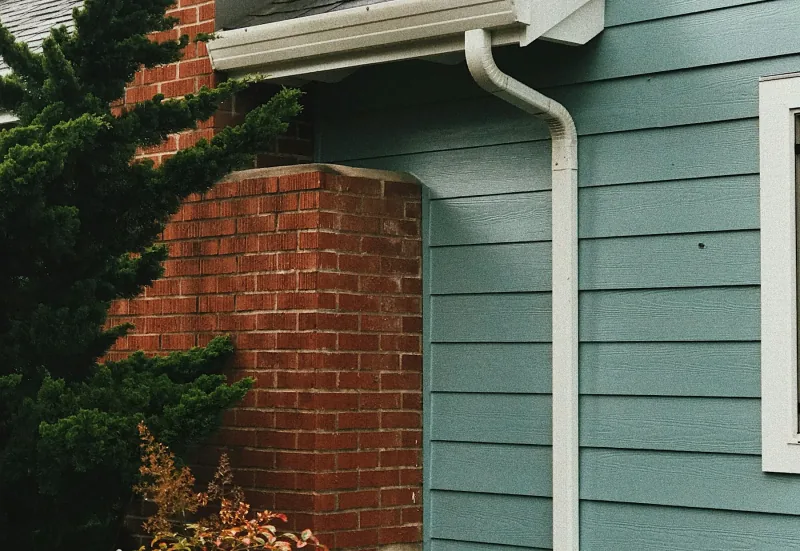
What Cherryville itself changes
The housing in Cherryville
Cherryville was incorporated in 1881, has a population of around 6,000 and is overwhelmingly owner-occupied older housing. Long ownership changes the gutter picture in a specific way: these houses have been maintained continuously by people who live in them, so what we find is rarely neglect and frequently the accumulated evidence of thirty years of well-meant repairs. Third-cycle gutter is the normal case, and the useful question is not how old the run is but how many times the fascia behind it has been fastened into.
What drops on these roofs
Established and moderate. A town of this age has street trees that have been in place for generations, so the older residential streets carry real canopy directly over the roofs, though the town is small enough and the lots generous enough that it is not the wall-to-wall cover found in the older Charlotte wards. Gaston County generally runs to more pine than Mecklenburg, and pine needles are the debris most likely to defeat a screen-type guard.
What is up there now
Spike-and-ferrule on the original systems where they survive, and a variety of owner-arranged replacements where they do not. Because homeowners here have often done a repair themselves at some point, it is common to find hidden hangers and spikes on the same run, and sealant of several different vintages in the same mitre. None of that is a problem in itself; what it means is that the board test is the only reliable guide to whether the run can be saved.