



A hundred-year metal fitted with a twenty-year bracket
Copper is the only gutter material where the metal itself is essentially never the limiting factor. Left to weather, a copper gutter will comfortably outlast the roof it hangs under and quite possibly the people who chose it. Which is why every failure worth discussing on a copper system is a failure of something else that was fitted to it.
Galvanic corrosion, and why the hanger decides the lifespan
Put two different metals in contact, add water with anything dissolved in it, and you have made a small battery. The less noble metal corrodes preferentially and the more noble one is protected. This is galvanic corrosion, it is entirely predictable from where the metals sit relative to each other, and a gutter is close to a laboratory demonstration of it: two metals in permanent contact, wet for days at a time, with rainwater carrying dissolved solids and whatever has washed off the roof.
Copper is a noble metal. Aluminium and ordinary steel are markedly less so. Fasten a copper gutter with aluminium hangers or plain steel screws and the hanger becomes the sacrificial part, not slowly, but as the actively corroding half of a cell that runs every time the gutter is wet. The copper stays immaculate. The bracket holding it up does not, and in fifteen years or so the run comes off a house whose gutter still looks new.
That is why a copper installation is specified all the way through, and why it costs what it costs:
- Copper or bronze hangers and fascia brackets, never aluminium and never zinc-plated steel.
- Copper or stainless fasteners. Stainless is acceptable and sits close enough to copper; plain or galvanised steel is not.
- Soldered joints, not sealant. A copper mitre or end cap is soldered, which makes it a continuation of the metal rather than a gap bridged with a compound that ages. This is the main reason copper takes a different skill set: the tradesman needs to solder on a ladder, and not every gutter fitter can.
- Copper downspouts and straps. Running copper gutter into an aluminium downspout puts the same cell at the outlet, which is the wettest point in the system.
There is one more contact worth knowing about, and it works the other way. Water running off a copper surface picks up copper ions, and if that runoff then crosses bare aluminium or galvanised steel further down (an aluminium roof flashing, a metal porch roof, a galvanised downspout below a copper gutter), it will corrode that surface. So the sequence matters: copper must be downstream of everything else it touches, never upstream of a lesser metal.
None of this is exotic and all of it is routinely got wrong, because a copper gutter can be hung with the aluminium hangers already on the truck and it will look perfect on handover day. The failure arrives a decade later, long after anyone is going to connect it to the decision.
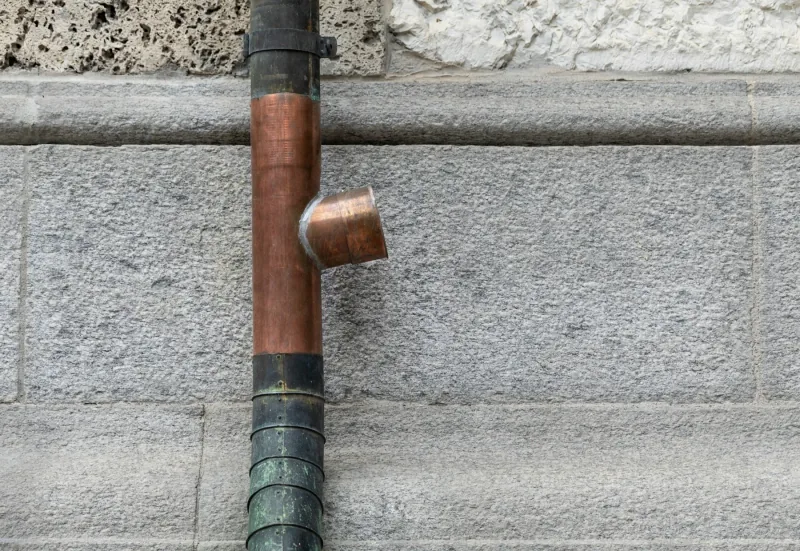
What it will actually look like in five years
New copper is bright and pink-orange, and almost nobody who buys copper is buying that. It is worth being clear about the sequence, because people are sometimes surprised by the middle of it.
Within weeks it dulls to a darker salmon. Over the first year or two in this climate it goes through browns and then to a deep chocolate-brown that is where most Charlotte copper actually sits and stays for a long time. The green-blue patina everyone pictures is a much slower process of decades, and it develops unevenly depending on exposure, rainfall and what is above it. A north elevation under trees and a south elevation in full sun will not match, and they never will.
Two practical notes. Copper runoff stains what it lands on, so a copper gutter above painted timber, light brickwork or a light-coloured path will leave a green-brown streak over time; that is worth designing around rather than discovering. And copper can be lacquered to hold the bright finish, which we will do if asked and generally advise against, because lacquer fails unevenly and stripping it back is more work than simply letting the metal do what it does.
When we would talk you out of it
Copper is four to five times the cost of aluminium and it is the right decision on a narrower set of houses than the price list suggests.
It earns its place on genuine period property (the historic districts in Salisbury, Statesville, Waxhaw and Charlotte's pre-1930 wards, where an aluminium half-round is a visible compromise on a building that deserves better), and on architect-specified work where the copper is a deliberate part of the elevation.
It does not earn its place on a 2000s subdivision house, and we will say so. The metal will not perform any better in the ways that actually matter on that house: a copper gutter overflows exactly as readily as an aluminium one if it is under-drained, because the problem was never the metal. If the goal is appearance, painted aluminium half-round at $16 to $26 a foot gets most of the way to the look for a third of the money, and the difference is genuinely hard to read from the street.
There is also a theft consideration that nobody enjoys raising. Copper downspouts at ground level on an unoccupied or set-back property are worth stealing, and it does happen. On a house where that is a real risk, one legitimate answer is copper gutter with the lower downspout sections in a different metal, which we will fit and detail properly rather than pretending the issue does not exist.
What the job covers in Charlotte
What we cover
Copper gutter and downspout installation across Charlotte and the surrounding counties, mostly on period property and architect-specified work.
Target outcome
A copper system whose fastenings, hangers and joints are all copper or compatible, so the metal is allowed to last as long as it can.
Decision point
We publish what copper costs and we will say plainly when a painted aluminium half-round would serve you better.