



Which Gastonia houses actually justify copper
Gastonia holds the largest share of aged housing in the region (52.4% of it predates 1980, against a Mecklenburg median of around 1997), and that single statistic decides what gutter work here looks like. Houses built before roughly the mid-1990s were gutted with spike-and-ferrule: a long nail driven through both walls of the gutter into the fascia. Nails hold by friction, friction fails once the timber gets wet, and forty years of wetting cycles have drawn most of them progressively outward. This is why so many Gastonia gutters carry a row of proud nail heads along the front, and why re-hanging rather than replacing is the dominant job in this town.
Copper earns its place on some of that and not on the rest, and we would rather say which before quoting four to five times the aluminium rate. It belongs on genuine period property, where an aluminium K-style run across original eaves detailing is a visible compromise on a building that deserves better, and on architect-specified work where the metal is a deliberate part of the elevation. On modern subdivision housing it performs no better in any way that matters, because an under-drained copper gutter overflows exactly like an under-drained aluminium one. If the appeal is the look, painted aluminium half-round at $16 to $26 a foot gets most of the way there for roughly a third of the money.
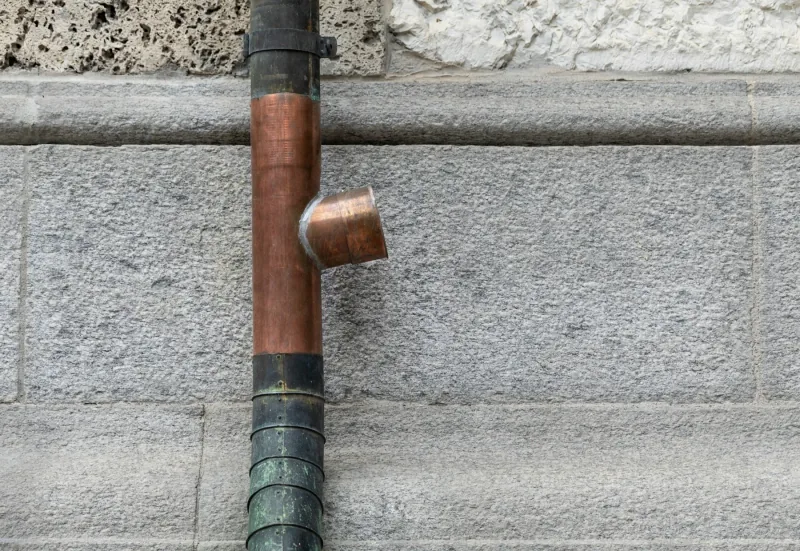
Where copper is right, the specification decides everything. Copper is a noble metal and aluminium is not, so a copper gutter on aluminium hangers makes the hanger the actively corroding half of a galvanic cell, wet, every time it rains, for years. The gutter stays immaculate and the bracket wastes away, and in fifteen years the run comes off a house whose owner was expecting a lifetime. Copper or bronze hangers, copper or stainless fasteners, copper downspouts and straps, and soldered joints rather than sealant.
One check specific to the property rather than the town: copper runoff corrodes bare aluminium and galvanised steel below it, so anything downstream on the elevation (flashings, a porch roof, an existing downspout) gets looked at before we hang a foot of it.
What Gastonia itself changes
What drops on these roofs
Mature and established, because the housing is old enough that the trees planted with it have had five or six decades to grow. The older neighbourhoods around the centre have the sort of hardwood canopy that arches over the street entirely, which is pleasant to live under and hard on gutters. The newer development at the edges of the city has the young cleared-and-replanted planting typical of its era and a much lighter debris load.
Getting to the gutters
Mostly single-storey and modest two-storey houses on regular lots, which keeps the access surcharge off a lot of Gastonia quotes and makes this one of the more affordable towns in the metro to have gutter work done. Driveways are generally adequate for the trailer. The complication is not height but ground: several of the older neighbourhoods sit on noticeable slopes, and a ladder position on a fall needs setting up properly rather than improvised.