



Which Mount Pleasant houses actually justify copper
Mount Pleasant has a listed historic district at its centre and newer building around the edges, and the distinction is unusually visible from the street. The older buildings were designed with deep overhangs, moulded fascia and decorative eaves detailing, and that detailing is exactly what a gutter has to be fitted to. On a house of that period the profile is an appearance decision as much as a drainage one, and a stock K-style run fastened across carved eaves reads as wrong even to somebody who could not say why.
Copper earns its place on some of that and not on the rest, and we would rather say which before quoting four to five times the aluminium rate. It belongs on genuine period property, where an aluminium K-style run across original eaves detailing is a visible compromise on a building that deserves better, and on architect-specified work where the metal is a deliberate part of the elevation. On modern subdivision housing it performs no better in any way that matters, because an under-drained copper gutter overflows exactly like an under-drained aluminium one. If the appeal is the look, painted aluminium half-round at $16 to $26 a foot gets most of the way there for roughly a third of the money.
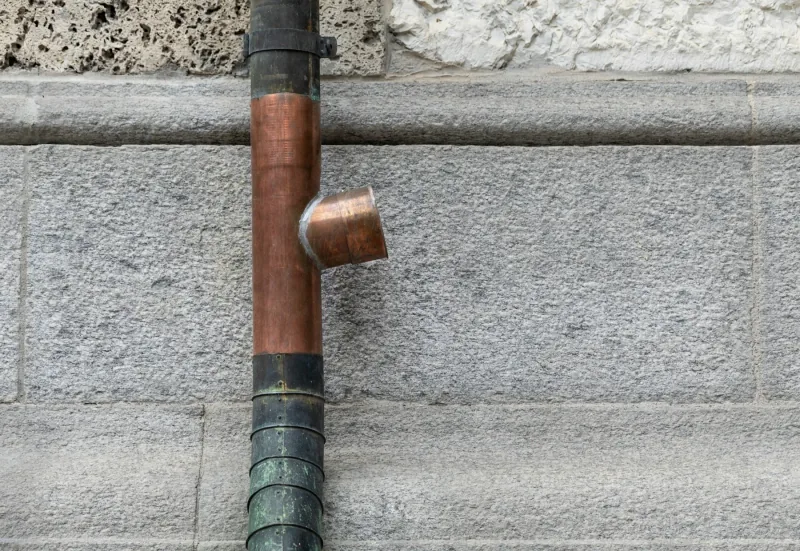
Where copper is right, the specification decides everything. Copper is a noble metal and aluminium is not, so a copper gutter on aluminium hangers makes the hanger the actively corroding half of a galvanic cell, wet, every time it rains, for years. The gutter stays immaculate and the bracket wastes away, and in fifteen years the run comes off a house whose owner was expecting a lifetime. Copper or bronze hangers, copper or stainless fasteners, copper downspouts and straps, and soldered joints rather than sealant.
One check specific to the property rather than the town: copper runoff corrodes bare aluminium and galvanised steel below it, so anything downstream on the elevation (flashings, a porch roof, an existing downspout) gets looked at before we hang a foot of it.
What Mount Pleasant itself changes
What drops on these roofs
The historic core has the substantial mature planting of a town centre that has stood for well over a century, with large hardwoods arching over the older streets and directly above the roofs. The newer edges are open and lightly planted. The debris difference across a few hundred yards is considerable, and it is another reason the older half of the town needs a different cleaning schedule from the newer half.
Getting to the gutters
The historic core has the constraints its period implies: narrow lots, buildings close to the street, tall elevations relative to footprint, and porches and bay features that put a run above a roof rather than above open ground. None of it is unmanageable and all of it is slower than open subdivision work. The newer edges are ordinary.