



Which Salisbury houses actually justify copper
Salisbury holds one of the most substantial historic housing stocks in North Carolina: the Salisbury Historic District with hundreds of contributing buildings, plus North Main Street from roughly 1900 to 1930, Brooklyn-South Square and North Long Street-Park Avenue. Late Victorian, Colonial Revival and Craftsman bungalows in real quantity. On buildings of that quality the gutter is part of the elevation rather than a utility bolted to it, and a stock K-style run in a modern finish is a visible compromise on a house that was designed with something else in mind.
Copper earns its place on some of that and not on the rest, and we would rather say which before quoting four to five times the aluminium rate. It belongs on genuine period property, where an aluminium K-style run across original eaves detailing is a visible compromise on a building that deserves better, and on architect-specified work where the metal is a deliberate part of the elevation. On modern subdivision housing it performs no better in any way that matters, because an under-drained copper gutter overflows exactly like an under-drained aluminium one. If the appeal is the look, painted aluminium half-round at $16 to $26 a foot gets most of the way there for roughly a third of the money.
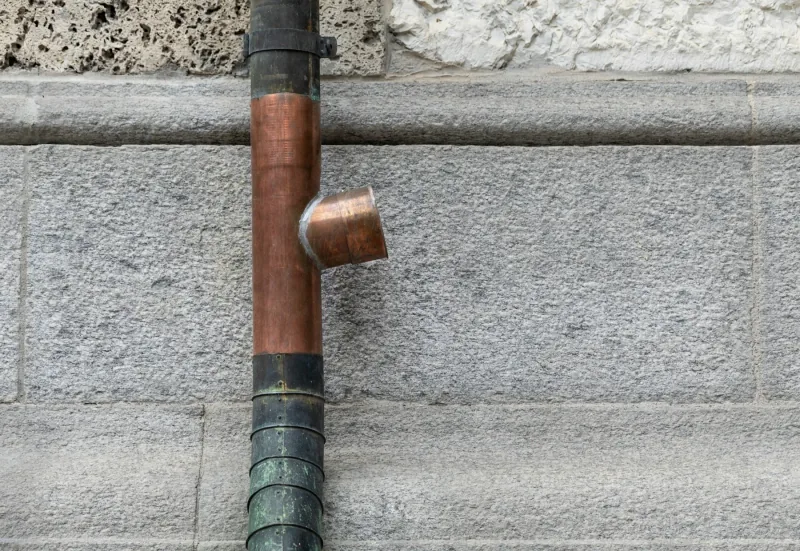
Where copper is right, the specification decides everything. Copper is a noble metal and aluminium is not, so a copper gutter on aluminium hangers makes the hanger the actively corroding half of a galvanic cell, wet, every time it rains, for years. The gutter stays immaculate and the bracket wastes away, and in fifteen years the run comes off a house whose owner was expecting a lifetime. Copper or bronze hangers, copper or stainless fasteners, copper downspouts and straps, and soldered joints rather than sealant.
One check specific to the property rather than the town: copper runoff corrodes bare aluminium and galvanised steel below it, so anything downstream on the elevation (flashings, a porch roof, an existing downspout) gets looked at before we hang a foot of it.
What Salisbury itself changes
What drops on these roofs
The historic districts have the mature, deliberately planted street canopy of a town that has been prosperous for a very long time, with large hardwoods over the roofs on most of those streets. It is a heavy and sustained debris load, and it falls on buildings where the cleaning access is among the most difficult in the service area. The newer development at the edges of the city is conventional and much lighter.
Getting to the gutters
Among the hardest in the service area, and for the same reason the buildings are worth looking at. Victorian and Craftsman houses are tall relative to their footprint, with steep pitches, turrets, dormers and wrap-around porches that put runs above roofs rather than above ground. A significant proportion of Salisbury historic work is roof access rather than ladder access and is quoted individually. This is not a town where a per-foot rate quoted over the phone means much.