



Which Iron Station houses actually justify copper
Iron Station is an unincorporated community rather than a town, and it has almost no uniform subdivision housing at all. Properties are rural and individual: older farmhouses, mid-century rural building, and modern houses on acreage, frequently with outbuildings that carry gutter of their own. There is no median that describes anything here and no comparable property to price from, so every Iron Station quote is a measured one. Anyone giving a firm number for an Iron Station address over the phone is guessing.
Copper earns its place on some of that and not on the rest, and we would rather say which before quoting four to five times the aluminium rate. It belongs on genuine period property, where an aluminium K-style run across original eaves detailing is a visible compromise on a building that deserves better, and on architect-specified work where the metal is a deliberate part of the elevation. On modern subdivision housing it performs no better in any way that matters, because an under-drained copper gutter overflows exactly like an under-drained aluminium one. If the appeal is the look, painted aluminium half-round at $16 to $26 a foot gets most of the way there for roughly a third of the money.
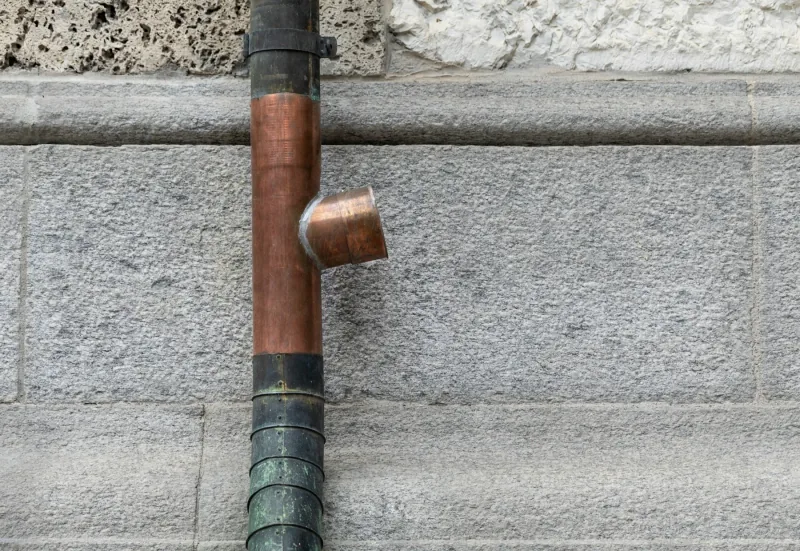
Where copper is right, the specification decides everything. Copper is a noble metal and aluminium is not, so a copper gutter on aluminium hangers makes the hanger the actively corroding half of a galvanic cell, wet, every time it rains, for years. The gutter stays immaculate and the bracket wastes away, and in fifteen years the run comes off a house whose owner was expecting a lifetime. Copper or bronze hangers, copper or stainless fasteners, copper downspouts and straps, and soldered joints rather than sealant.
One check specific to the property rather than the town: copper runoff corrodes bare aluminium and galvanised steel below it, so anything downstream on the elevation (flashings, a porch roof, an existing downspout) gets looked at before we hang a foot of it.
What Iron Station itself changes
What drops on these roofs
Determined entirely by the individual parcel. Rural Lincoln County retains substantial mixed hardwood and pine along field margins and watercourses, so a house sited near a treeline carries a heavy and largely pine-driven debris load while a house in open ground a few hundred yards away carries very little. Assessment here is per property rather than per area, and we would rather look than assume.
Getting to the gutters
Long unpaved drives are the practical constraint. Getting the trailer to the house can mean a considerable distance on a surface that changes character after rain, and ground around rural buildings is generally unmade and uneven, so ladder footings need proper setting up rather than improvising. Outbuildings are usually easy in themselves but add runs and add walking.