



Which Denver houses actually justify copper
Denver occupies the Lake Norman end of Lincoln County and its housing is largely post-2000, concentrated in waves through that decade, with older rural properties scattered between. What matters for gutters is the scale rather than the age: these are big houses on big lots, and big houses have big uninterrupted roof planes. Denver is the one town in this service area where 6-inch gutter and 3x4 downspouts are routinely the correct specification rather than an upsell, because the roof areas genuinely warrant the capacity.
Copper earns its place on some of that and not on the rest, and we would rather say which before quoting four to five times the aluminium rate. It belongs on genuine period property, where an aluminium K-style run across original eaves detailing is a visible compromise on a building that deserves better, and on architect-specified work where the metal is a deliberate part of the elevation. On modern subdivision housing it performs no better in any way that matters, because an under-drained copper gutter overflows exactly like an under-drained aluminium one. If the appeal is the look, painted aluminium half-round at $16 to $26 a foot gets most of the way there for roughly a third of the money.
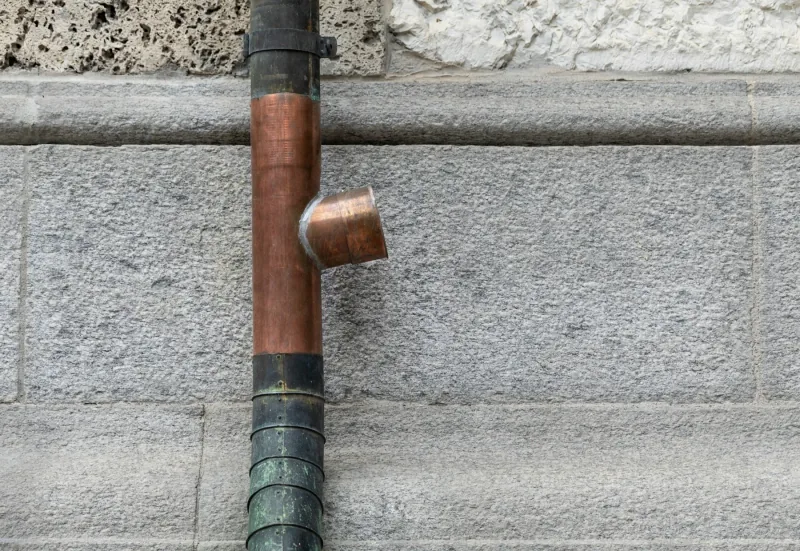
Where copper is right, the specification decides everything. Copper is a noble metal and aluminium is not, so a copper gutter on aluminium hangers makes the hanger the actively corroding half of a galvanic cell, wet, every time it rains, for years. The gutter stays immaculate and the bracket wastes away, and in fifteen years the run comes off a house whose owner was expecting a lifetime. Copper or bronze hangers, copper or stainless fasteners, copper downspouts and straps, and soldered joints rather than sealant.
One check specific to the property rather than the town: copper runoff corrodes bare aluminium and galvanised steel below it, so anything downstream on the elevation (flashings, a porch roof, an existing downspout) gets looked at before we hang a foot of it.
What Denver itself changes
What drops on these roofs
Variable, and generally lighter than the Mecklenburg towns. Much of the post-2000 development was built on open or cleared land with planting that is still well short of the rooflines, though the lakeside and creek-adjacent lots retain mature growth. The older rural properties scattered between the developments sit in a different situation entirely, often close to established treelines with a much heavier seasonal load.
Getting to the gutters
Large houses mean tall elevations, and a meaningful share of Denver work involves runs at genuine two-and-a-half or three-storey height, particularly on properties built into the fall of the land towards the water. Drives are long and generous so trailer positioning is easy, but the walk from the trailer to the far elevation of a large house on a large lot is a real component of the day.