



Which Concord houses actually justify copper
Concord is the clearest example in the metro of a town on its first set of gutters. The median home here was built in 1998 and 46.9% of the stock went up in 2000 or later, which means the great majority of these houses still carry the aluminium the builder hung, now somewhere between twenty-five and forty years old. That matters because aluminium does not really wear out in that time. What has aged is everything around it: the sealant in the mitres has gone brittle, the fasteners have taken thousands of wetting cycles, and the downspout count was decided by whoever was pricing the subdivision rather than by the roof.
Copper earns its place on some of that and not on the rest, and we would rather say which before quoting four to five times the aluminium rate. It belongs on genuine period property, where an aluminium K-style run across original eaves detailing is a visible compromise on a building that deserves better, and on architect-specified work where the metal is a deliberate part of the elevation. On modern subdivision housing it performs no better in any way that matters, because an under-drained copper gutter overflows exactly like an under-drained aluminium one. If the appeal is the look, painted aluminium half-round at $16 to $26 a foot gets most of the way there for roughly a third of the money.
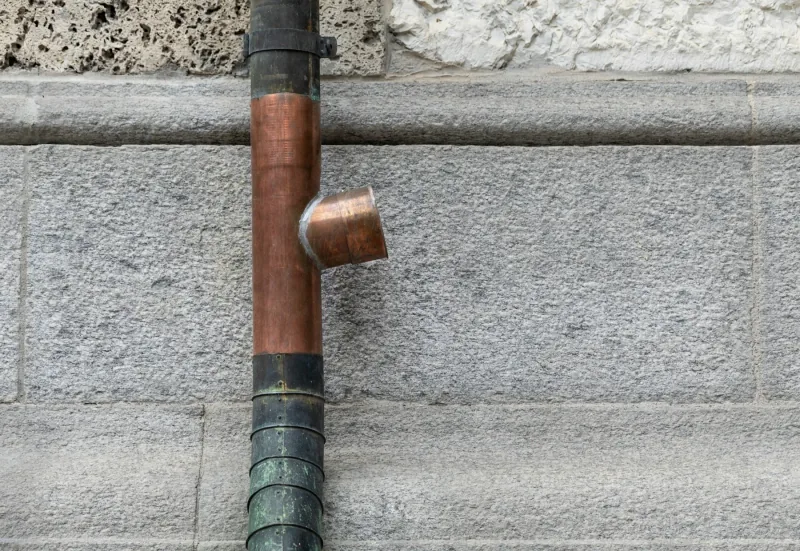
Where copper is right, the specification decides everything. Copper is a noble metal and aluminium is not, so a copper gutter on aluminium hangers makes the hanger the actively corroding half of a galvanic cell, wet, every time it rains, for years. The gutter stays immaculate and the bracket wastes away, and in fifteen years the run comes off a house whose owner was expecting a lifetime. Copper or bronze hangers, copper or stainless fasteners, copper downspouts and straps, and soldered joints rather than sealant.
One check specific to the property rather than the town: copper runoff corrodes bare aluminium and galvanised steel below it, so anything downstream on the elevation (flashings, a porch roof, an existing downspout) gets looked at before we hang a foot of it.
What Concord itself changes
What drops on these roofs
The 1990s and 2000s subdivisions that make up most of Concord were cleared and replanted rather than built into existing woodland, so the trees over these roofs are twenty-five to thirty-year-old ornamentals and shade trees planted with the houses. They are now big enough to reach the eaves on the older streets and getting bigger every year, which is why gutter cleaning demand here has risen steadily on houses that genuinely did not need it for their first decade. The mature canopy is concentrated around the historic downtown rather than in the newer development.
Getting to the gutters
Overwhelmingly two-storey subdivision houses with wide driveways and generous side access, which makes Concord one of the easier towns in the metro to work in and one of the easier to quote accurately over the phone. Ladder positions are level and the trailer can usually get within a few feet of every elevation. The exception is the older stock around Union Street downtown, where lots are narrower, the houses are taller relative to their footprint, and a run over a porch roof often needs planning rather than a ladder.