



What profile will actually fit in Concord
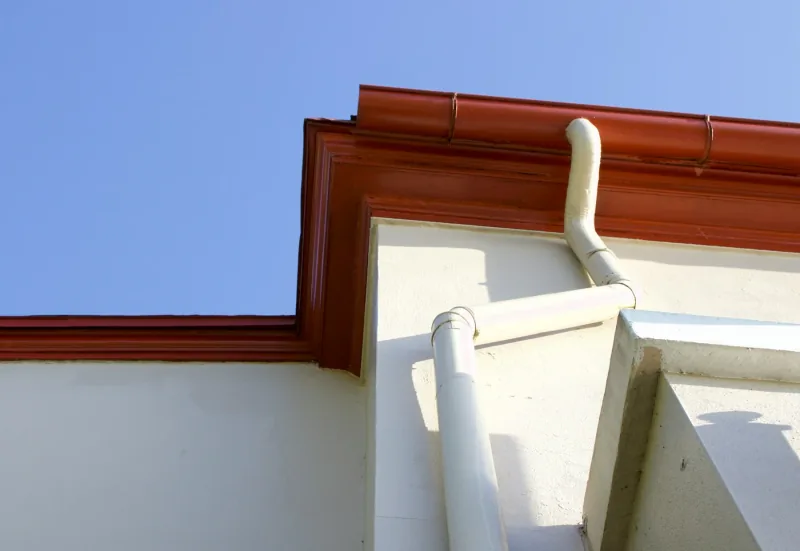
Almost universally 5-inch K-style aluminium in the builder standard, hung on hidden hangers rather than spikes, because Concord built late enough to have largely missed the spike era. That is good news: the fastening is usually sound and the fascia usually is too. The weak point here is the downspouts, which on subdivision work of this period were specified at 2x3 and at the minimum number that would pass. Adding a drop or upsizing to 3x4 is the single most useful thing most Concord houses can have done.
Seamless does not change any of that, and it is worth being precise about what it does change. The machine sits on a trailer at the kerb and rolls flat aluminium coil into finished profile at whatever length is called for, so a 46-foot elevation becomes one 46-foot piece with no joint anywhere along it. Sectional gutter would have four connectors in that run, each one a place for sealant to fail and debris to catch.
What seamless does not remove is the joints at the corners and the end caps, and those are where gutters actually leak, because a mitre sits where two roof planes deliver water at once and at speed. That is why we hand-mitre, two pieces cut to the true angle of your roof rather than a factory 90 riveted in, and why it is included in the rate rather than sold as an upgrade.
The other question Concord raises is whether the profile you want will physically sit under the roof edge. Shallow overhangs on older housing frequently rule out 6-inch entirely, and finding that out on the day is somebody's problem. We measure the eaves before ordering, and where more capacity is genuinely needed but a wider trough will not fit, the answer is an additional downspout, which is cheaper anyway.
What Concord itself changes
The housing in Concord
Concord is the clearest example in the metro of a town on its first set of gutters. The median home here was built in 1998 and 46.9% of the stock went up in 2000 or later, which means the great majority of these houses still carry the aluminium the builder hung, now somewhere between twenty-five and forty years old. That matters because aluminium does not really wear out in that time. What has aged is everything around it: the sealant in the mitres has gone brittle, the fasteners have taken thousands of wetting cycles, and the downspout count was decided by whoever was pricing the subdivision rather than by the roof.
What drops on these roofs
The 1990s and 2000s subdivisions that make up most of Concord were cleared and replanted rather than built into existing woodland, so the trees over these roofs are twenty-five to thirty-year-old ornamentals and shade trees planted with the houses. They are now big enough to reach the eaves on the older streets and getting bigger every year, which is why gutter cleaning demand here has risen steadily on houses that genuinely did not need it for their first decade. The mature canopy is concentrated around the historic downtown rather than in the newer development.