



What profile will actually fit in Harrisburg
5-inch K-style aluminium on hidden hangers, built late enough to have missed the spike era entirely, with 2x3 downspouts at builder-minimum count. Because the fastening and the fascia are both young and sound, Harrisburg is the town where replacement quotes are least justified. Almost everything presenting as a problem here (sagging, mitres weeping, water over the front edge) is a re-hang, a joint or an extra downspout rather than new metal.
Seamless does not change any of that, and it is worth being precise about what it does change. The machine sits on a trailer at the kerb and rolls flat aluminium coil into finished profile at whatever length is called for, so a 46-foot elevation becomes one 46-foot piece with no joint anywhere along it. Sectional gutter would have four connectors in that run, each one a place for sealant to fail and debris to catch.
What seamless does not remove is the joints at the corners and the end caps, and those are where gutters actually leak, because a mitre sits where two roof planes deliver water at once and at speed. That is why we hand-mitre, two pieces cut to the true angle of your roof rather than a factory 90 riveted in, and why it is included in the rate rather than sold as an upgrade.
The other question Harrisburg raises is whether the profile you want will physically sit under the roof edge. Shallow overhangs on older housing frequently rule out 6-inch entirely, and finding that out on the day is somebody's problem. We measure the eaves before ordering, and where more capacity is genuinely needed but a wider trough will not fit, the answer is an additional downspout, which is cheaper anyway.
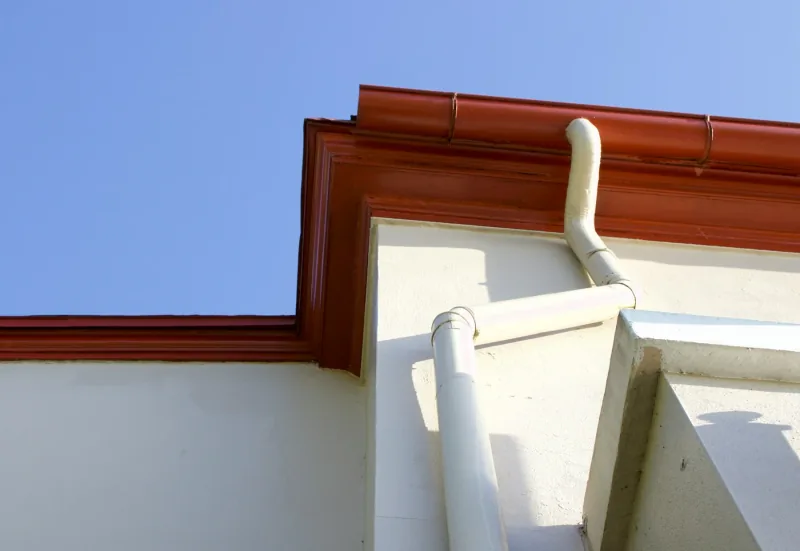
What Harrisburg itself changes
The housing in Harrisburg
Harrisburg went from a crossroads to a commuter town inside about twenty years, in subdivision waves running from the late 1990s onward, and whole streets here were completed within a year or two of each other. The gutters therefore reach every stage of their life together. What makes Harrisburg genuinely different from the other concentrated-cohort towns is how recent that building is: the fascia boards on most of these houses are twenty-five years old at the outside, and a young sound board is what makes a re-hang possible instead of a replacement.
What drops on these roofs
Light. The subdivisions were built on farmland and the planted trees are still mostly at or below eaves height, so the annual debris load on a typical Harrisburg house is modest and a single yearly clean is usually enough. The older houses along the original crossroads and the properties backing onto the remaining woodland at the town’s edges are the exceptions, and they behave more like Mint Hill than like the rest of Harrisburg.