



What profile will actually fit in Waxhaw
6-inch K-style aluminium is more common here than anywhere else on this list, because the roof planes on these houses are genuinely large enough to need it, and it was frequently specified from new. The failing is still the outlets: a 2x3 downspout under a large 6-inch run is a bottleneck that makes the wider gutter pointless. Downtown, the historic buildings want half-round, and copper is specified there more often than in any other town in the service area.
Seamless does not change any of that, and it is worth being precise about what it does change. The machine sits on a trailer at the kerb and rolls flat aluminium coil into finished profile at whatever length is called for, so a 46-foot elevation becomes one 46-foot piece with no joint anywhere along it. Sectional gutter would have four connectors in that run, each one a place for sealant to fail and debris to catch.
What seamless does not remove is the joints at the corners and the end caps, and those are where gutters actually leak, because a mitre sits where two roof planes deliver water at once and at speed. That is why we hand-mitre, two pieces cut to the true angle of your roof rather than a factory 90 riveted in, and why it is included in the rate rather than sold as an upgrade.
The other question Waxhaw raises is whether the profile you want will physically sit under the roof edge. Shallow overhangs on older housing frequently rule out 6-inch entirely, and finding that out on the day is somebody's problem. We measure the eaves before ordering, and where more capacity is genuinely needed but a wider trough will not fit, the answer is an additional downspout, which is cheaper anyway.
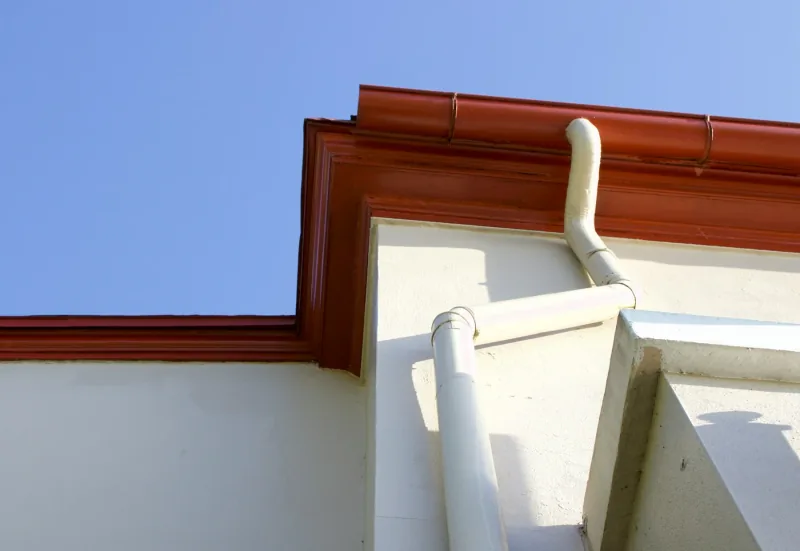
What Waxhaw itself changes
The housing in Waxhaw
Waxhaw built hard through the 2000s (2,282 homes went up between 2000 and 2009, and only 8.3% of the stock dates from 2020 or later), and what it built was tall. The dominant form here is the large two-storey and part three-storey colonial on a generous lot, which is the single most expensive shape of house to put gutters on anywhere in this service area. Downtown, in complete contrast, sits a 93-building National Register district built between 1888 and 1940 with the railway running through the middle of it, where the buildings are old, the eaves are decorative and a stock K-style profile is visibly wrong.
What drops on these roofs
The 2000s subdivisions were laid out on farmland and retain scattered mature specimen trees that were kept during development, which produces an unusual pattern: most houses on a street have a light debris load and two or three have a heavy one because a large oak was left standing next to them. Downtown has the established planting of a town that has been there since the 1880s. Assessing Waxhaw by street average is misleading; it needs the individual lot.