



What actually falls on Waxhaw roofs, and when
The 2000s subdivisions were laid out on farmland and retain scattered mature specimen trees that were kept during development, which produces an unusual pattern: most houses on a street have a light debris load and two or three have a heavy one because a large oak was left standing next to them. Downtown has the established planting of a town that has been there since the 1880s. Assessing Waxhaw by street average is misleading; it needs the individual lot.
That is the part national advice cannot tell you. Almost every article on this subject says twice a year, spring and autumn, and books the autumn visit for October. Across this metro that timing is wrong, because the dominant street tree is the willow oak (roughly 200,000 street trees in Charlotte, a significant share of them oak), and willow oak holds its leaves late, dropping through late autumn and into winter rather than in one convenient fortnight. A single clean booked for October happens in the middle of the drop rather than at the end of it.
So under real canopy the useful pattern in Waxhaw is one visit once the drop has genuinely finished, in late December or January, and a second in spring, which here is not a leaf job at all. Spring is pine pollen, catkins and seed, and it washes into the outlets and sets there. A spring visit is a downspout job with a gutter attached.
Whatever the schedule, the visit finishes the same way anywhere we work: hand-cleared into a bucket rather than blown off the roof, every downspout flow-tested with a hose, and photographs from the ladder of every run before and after. You are hiring us precisely because you are not going up there, so you get the evidence rather than the assurance.
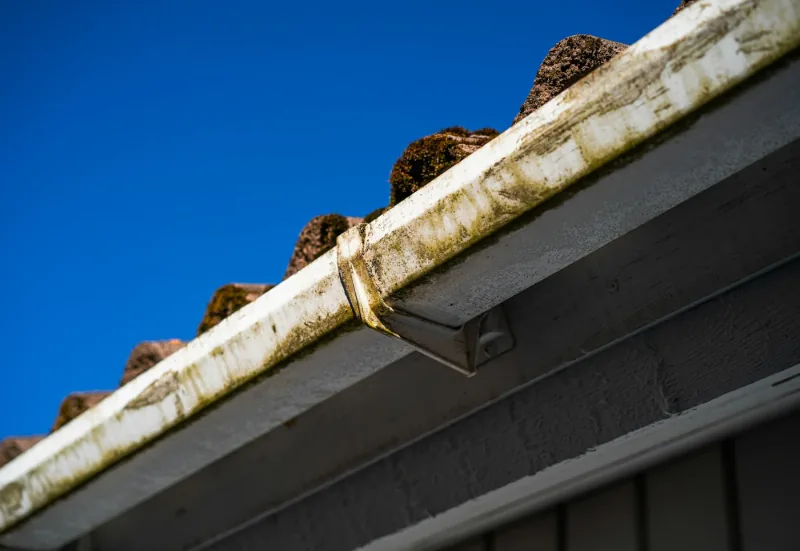
What Waxhaw itself changes
Getting to the gutters
This is the town where the access surcharge does most of its work. Two full storeys with a steep pitch above them is the norm rather than the exception, and a meaningful number of properties have gable-end elevations reaching close to three storeys where the land falls away. Ladder work stops being viable at that point and the job becomes roof access, which is quoted individually. Driveways are long and generous, so getting the trailer close is rarely the problem.
The housing in Waxhaw
Waxhaw built hard through the 2000s (2,282 homes went up between 2000 and 2009, and only 8.3% of the stock dates from 2020 or later), and what it built was tall. The dominant form here is the large two-storey and part three-storey colonial on a generous lot, which is the single most expensive shape of house to put gutters on anywhere in this service area. Downtown, in complete contrast, sits a 93-building National Register district built between 1888 and 1940 with the railway running through the middle of it, where the buildings are old, the eaves are decorative and a stock K-style profile is visibly wrong.