



What actually falls on Stallings roofs, and when
Light to moderate, and similar in character to neighbouring Indian Trail, farmland converted to subdivision, with planted trees that are only now reaching the height of the eaves on the earliest streets. The debris load is genuinely low by metro standards. What Stallings does get, like the whole of the Union County side, is the spring pine pollen and catkin drop, which washes into the outlets and sets there, so the spring visit here is a downspout job with a gutter attached.
That is the part national advice cannot tell you. Almost every article on this subject says twice a year, spring and autumn, and books the autumn visit for October. Across this metro that timing is wrong, because the dominant street tree is the willow oak (roughly 200,000 street trees in Charlotte, a significant share of them oak), and willow oak holds its leaves late, dropping through late autumn and into winter rather than in one convenient fortnight. A single clean booked for October happens in the middle of the drop rather than at the end of it.
So under real canopy the useful pattern in Stallings is one visit once the drop has genuinely finished, in late December or January, and a second in spring, which here is not a leaf job at all. Spring is pine pollen, catkins and seed, and it washes into the outlets and sets there. A spring visit is a downspout job with a gutter attached.
Whatever the schedule, the visit finishes the same way anywhere we work: hand-cleared into a bucket rather than blown off the roof, every downspout flow-tested with a hose, and photographs from the ladder of every run before and after. You are hiring us precisely because you are not going up there, so you get the evidence rather than the assurance.
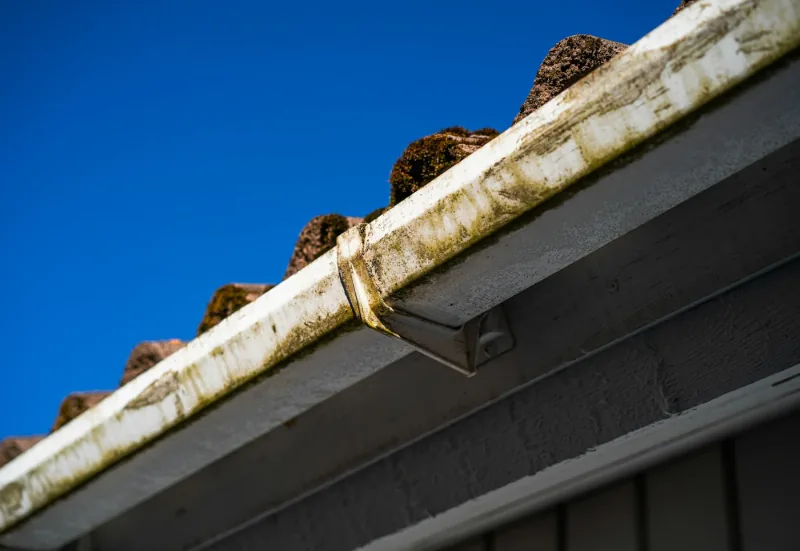
What Stallings itself changes
Getting to the gutters
Uniform and easy. The town is essentially one large cohort of subdivision housing with the layout that implies: level drives, standard setbacks, two-storey elevations of predictable height. There is very little in Stallings that needs anything other than a ladder and a normal working position, which keeps quotes here at the lower end of the access range.
The housing in Stallings
At 62.6% built between 1990 and 2009, Stallings has the most concentrated housing cohort of any town in this study, and with a median of 2002 that cohort has now arrived at a very specific age. Aluminium at twenty-four years is nowhere near finished. The sealant in its mitres and end caps is a different matter: it is a compound with a service life measured in one to two decades, not the same as the metal it sits in, and across Stallings it is reaching the end of that life more or less simultaneously. Almost every gutter call we take from this town is a corner that has started weeping.