



What actually falls on Cornelius roofs, and when
Moderate on the lots themselves, and the interesting part is what arrives from elsewhere. Wind coming across open water carries leaves, pine needles and seed laterally onto lakeside roofs from trees that are not on the property and sometimes not on the street, which is why lakeside houses here fill up faster than their own planting would predict. Homeowners routinely tell us they have no trees, and their gutters are full, and both of those are true.
That is the part national advice cannot tell you. Almost every article on this subject says twice a year, spring and autumn, and books the autumn visit for October. Across this metro that timing is wrong, because the dominant street tree is the willow oak (roughly 200,000 street trees in Charlotte, a significant share of them oak), and willow oak holds its leaves late, dropping through late autumn and into winter rather than in one convenient fortnight. A single clean booked for October happens in the middle of the drop rather than at the end of it.
So under real canopy the useful pattern in Cornelius is one visit once the drop has genuinely finished, in late December or January, and a second in spring, which here is not a leaf job at all. Spring is pine pollen, catkins and seed, and it washes into the outlets and sets there. A spring visit is a downspout job with a gutter attached.
Whatever the schedule, the visit finishes the same way anywhere we work: hand-cleared into a bucket rather than blown off the roof, every downspout flow-tested with a hose, and photographs from the ladder of every run before and after. You are hiring us precisely because you are not going up there, so you get the evidence rather than the assurance.
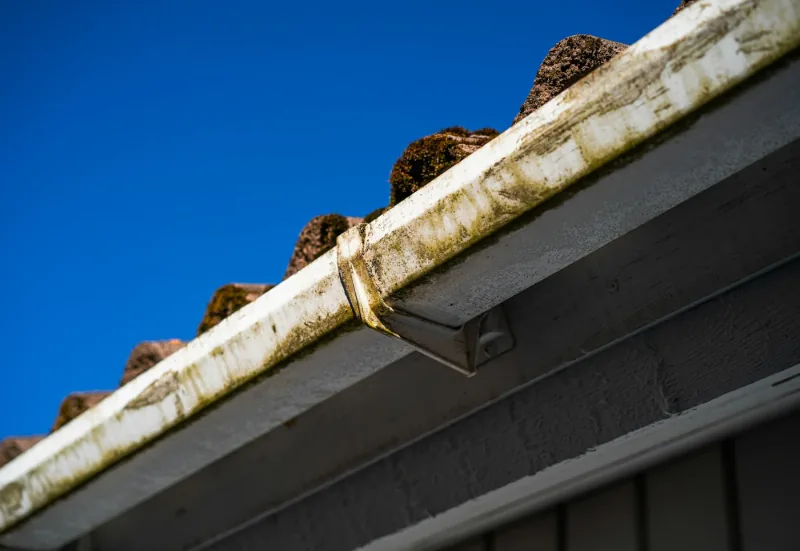
What Cornelius itself changes
Getting to the gutters
Generally good, with the significant exception of the lake side. Houses built into the fall of the land towards the water are frequently a storey taller on the lake elevation than they appear from the road, and the ground below that elevation is often sloped, terraced or decked. That is the run most likely to be blocked and the hardest to reach, so it gets quoted individually rather than under a flat surcharge.
The housing in Cornelius
Cornelius is a steady two-decade town (24.1% of the housing built in the 1990s and 32.5% in the 2000s, with a median of 2002), which gives it an unusually even spread of gutter ages rather than the single cohort of its Union County counterparts. Failures here are spread out rather than arriving street by street. What sets Cornelius apart is not the housing age at all but where the housing is: a large share of it is on or near the Lake Norman shore, and that changes the debris problem in a way the build year does not describe.