



What actually falls on Troutman roofs, and when
The village centre has mature planting typical of an established small town, with real canopy over the older streets. The new subdivision ring was built on former farmland and its trees have barely started, so debris load there is minimal for now and will rise steadily over the next fifteen years as the planting matures, the same trajectory Matthews has already completed.
That is the part national advice cannot tell you. Almost every article on this subject says twice a year, spring and autumn, and books the autumn visit for October. Across this metro that timing is wrong, because the dominant street tree is the willow oak (roughly 200,000 street trees in Charlotte, a significant share of them oak), and willow oak holds its leaves late, dropping through late autumn and into winter rather than in one convenient fortnight. A single clean booked for October happens in the middle of the drop rather than at the end of it.
So under real canopy the useful pattern in Troutman is one visit once the drop has genuinely finished, in late December or January, and a second in spring, which here is not a leaf job at all. Spring is pine pollen, catkins and seed, and it washes into the outlets and sets there. A spring visit is a downspout job with a gutter attached.
Whatever the schedule, the visit finishes the same way anywhere we work: hand-cleared into a bucket rather than blown off the roof, every downspout flow-tested with a hose, and photographs from the ladder of every run before and after. You are hiring us precisely because you are not going up there, so you get the evidence rather than the assurance.
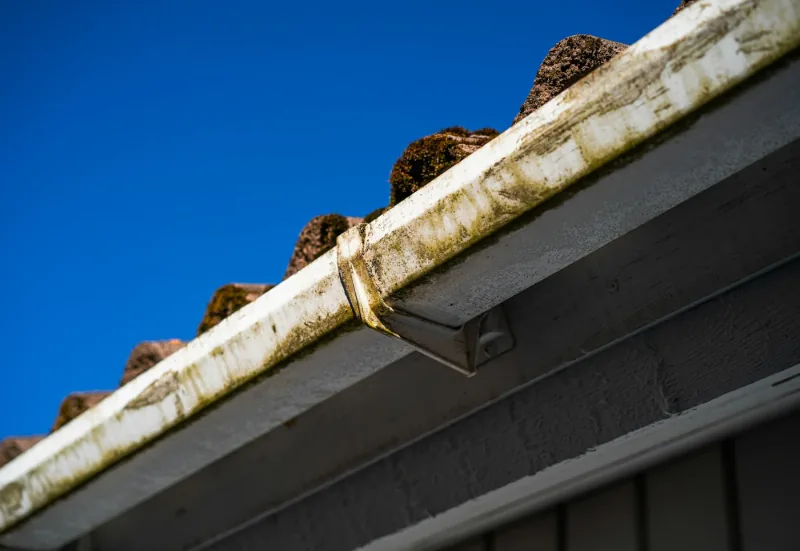
What Troutman itself changes
Getting to the gutters
The new development is straightforward two-storey work on level ground with proper drives. The older centre has tighter lots and a number of properties with porch roofs and additions that put a run above a roof rather than above ground. Neither half is difficult; establishing which half an address is in before quoting matters more here than the specifics of either.
The housing in Troutman
Troutman sits on the I-77 corridor between Statesville and Mooresville and has an older village centre with a rapidly expanding ring of new subdivision around it. The two are close enough together that a single afternoon can take in both, and they need entirely different conversations: century-old woodwork and unknown repair history in the centre, and first-cycle aluminium on sound new fascia a mile out. Troutman is the clearest small-scale illustration in the service area of why the postal town tells you almost nothing about the job.