



The one job you buy and cannot inspect
Almost every trade you hire leaves behind something you can look at. This one does not. The whole reason to hire a gutter cleaner is that the gutter is somewhere you have decided not to go, so the work happens in the one place on your property you will never check. That asymmetry shapes everything about how this service should be sold, and almost nobody sells it that way.
Photographs of every downspout, because you are never going to see them
A Charlotte homeowner asked the obvious question in a public thread a few years ago: are there untrustworthy gutter cleaners? It would be easy to follow up by inspecting the gutters. It is a fair question and it has an awkward answer, which is that the people asking it are, almost without exception, the people who have already decided not to climb a ladder. The threads that ask for a gutter cleaner in this city say so explicitly and have done for over a decade: I have second story gutters and I'm not getting on a ladder that high. I'm terrified of heights. I am not great with heights and it is a two-story building.
So the verification problem is structural. You cannot inspect the thing you are paying someone else to reach. And that means the honest response is not a promise, it is evidence.
Every clean we do finishes the same way. Photographs from the ladder of each run before and after, so you can see what came out. Each downspout individually flow-tested with a hose and filmed running clear at the bottom, because a gutter can be spotless and still be useless if the top elbow is packed. And a written note of anything we found that is a repair rather than a clean: a hanger that has let go, a mitre weeping, a section of fascia that has gone soft, a nest.
The flow test is the part that matters most and the part most often skipped. Debris migrates to the outlet, packs into the tightest turn in the whole system, the elbow at the top of the downspout, and sets. A cleaner working from the roof with a blower can leave a gutter looking immaculate from above while that plug stays exactly where it was. The gutter then overflows in the next real rain, and from the ground it looks like the clean was never done at all. Sometimes it was not. Sometimes it was, and only the last three feet were missed.
None of this is expensive to do. It adds perhaps fifteen minutes to a visit. It is simply not what gets offered when the customer has no way to tell the difference, which is exactly why we lead with it.
One more thing that follows from the same logic: we hand-clear rather than blow from the roof wherever the pitch allows. Blowing is faster and it is what the debris-into-the-flowerbeds complaint is about. Hand-clearing into a bucket means the silt layer at the bottom comes out too, and that layer is what holds water against the metal for the other fifty-one weeks of the year.
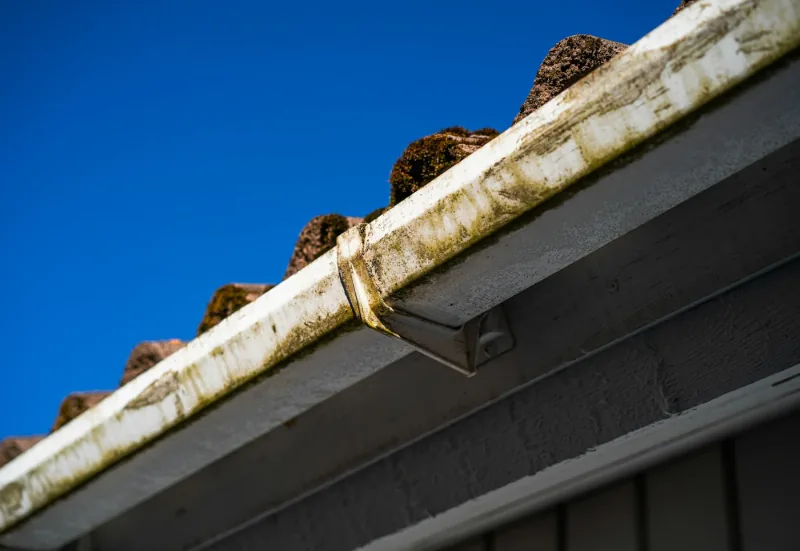
Charlotte gutters do not fill on the national schedule
Almost every article about gutter cleaning tells you to do it twice a year, in spring and in autumn, and to book the autumn one for October. That advice is written for maple and sycamore country. It does not describe this city.
Charlotte's canopy covers something like 45% of the city and the dominant street tree, out of roughly 200,000 of them, is the willow oak. Willow oak does two things that matter to a gutter. It holds its leaves late, dropping through late autumn and well into winter rather than in one convenient October fortnight. And its leaves are narrow and small, a few inches long and under an inch wide, rather than broad and flat.
The first fact breaks the calendar: a single autumn clean booked for October is done before the drop has finished, and the gutter refills through December on a house whose owner believes it was dealt with. Under heavy willow oak, the useful timing is one clean once the drop has genuinely finished, in late December or January, rather than one in the middle of it.
The second fact breaks a lot of gutter guards, which is covered on the guards page, and it also changes what the debris is. Small narrow leaves and the grit that washes off an asphalt roof pack into a dense silt rather than a loose pile, and silt does not blow out. It has to be lifted.
Spring is its own event here and it is not leaves. Pine pollen and the seed and catkin drop coat everything for a few weeks and then wash into the gutters, where they turn to a paste that sets in the outlets. A spring visit in this city is a downspout job with some gutter attached, which is the reverse of how it is usually sold.
Should you just do it yourself?
Sometimes, and we would rather say so than pretend otherwise. The DIY case was put well by a Charlotte resident in one of those same threads: wait for a few dry days, get up there with a blower, and it takes ten minutes.
That is genuinely true on a single-storey house with a walkable pitch, a stable ladder position and no willow oak overhead. If that describes you, the money is better spent elsewhere.
It stops being true on the second storey, and the reason is not difficulty. Ladder falls are the serious domestic injury in this category, and the height at which a fall stops being an inconvenience is roughly the height at which people start looking for a cleaner, which is why every Charlotte thread on this subject is about a two-storey house. It also stops being true where the only ladder footing is a slope or a deck, where the roof pitch is steep enough that you would be working off the ladder rather than the roof, and where the run you actually need to reach is the one over the conservatory.
Our honest position: below one storey with easy access, do it yourself. Above that, the reason to pay someone is not that it is hard. It is that you should not be up there.
What the job covers in Charlotte
What we cover
Residential gutter and downspout clearing across Charlotte and the surrounding counties, single-storey through three-storey.
Target outcome
Gutters and downspouts running clear, debris bagged and taken away, and photographic evidence that both are true.
Decision point
Published prices by storey and footage, and a written note of anything we found that needs a repair rather than a clean.