



Sealant is a symptom, not a repair
A gutter that leaks at a joint is a gutter whose joint is moving, and joints move because something behind them has let go. Running a bead of sealant along it addresses the gap and not the movement, which is why the same corner leaks again the following spring and why so many Charlotte gutters carry three visible generations of somebody else’s attempt.
Most gutter failure in this city starts in the fascia board
A gutter is held onto a house by fasteners driven into one piece of timber: the fascia, the board that closes off the ends of the rafters at the eaves. Everything else about the system is downstream of whether that board can still hold a screw.
The failure runs in a loop, and once you see it the diagnosis is usually obvious from the ground. Debris and silt hold water in the gutter. Standing water finds the joint between the back of the gutter and the fascia, a joint that on many houses is not properly closed by a drip edge, so water can run behind the metal rather than into it. The board gets repeatedly wet, then stays wet, and softens. A softened board gives up its grip on whatever is fastening the gutter to it. The run drops slightly at that point, which changes the pitch, which makes water pond exactly there, which wets the board harder. Each stage makes the next one worse.
Which fastener is in the board decides how fast that loop runs. Spike-and-ferrule (a long nail through both walls of the gutter, standard on Charlotte houses built before roughly the mid-1990s and still used by cheap installers) fails fastest, because a nail's grip depends entirely on friction along its shank and wet wood gives that up first. Every thermal cycle and every load of wet debris draws it out a fraction. Once it is proud you cannot fix it by hammering it back, because the hole is now larger than the nail. Hidden hangers, a bracket clipped inside the gutter with a screw through the back into the fascia, hold far better, because a screw thread engages wood rather than gripping it, and they spread the load over a bracket rather than a nail head.
So the honest sequence on any leaking or sagging gutter is: test the board first, choose the fastening second, and only then talk about sealant. If the board is sound, a re-hang on hidden hangers at 24-inch centres with the pitch reset costs a few dollars a foot and lasts. If the board is soft, replacing the affected fascia is the repair, and hanging new gutter on wet timber is simply buying the same failure again at full price.
This is also why we will re-hang before we replace. A run that sags, leaks at the mitres and holds water usually has nothing wrong with the aluminium at all. Turning down a replacement is a smaller invoice for us and it is the right answer often enough that we publish it as a rule.
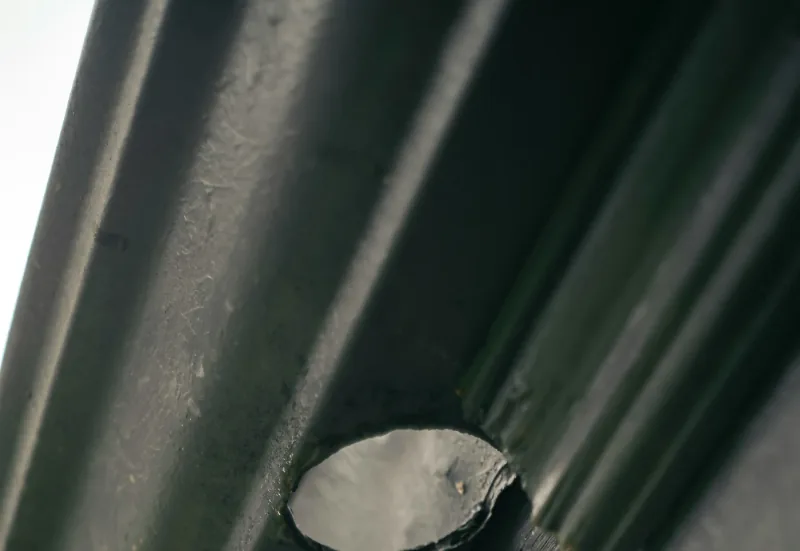
The five repairs that cover almost everything
Re-hang and re-pitch. The run is sound but sagging or holding water. Hangers replaced at 24-inch centres and the fall reset towards the outlet. Priced per foot. This is the most common repair we do and it is the one most often quoted as a replacement.
Mitres and end caps. Seamless gutter has no seam along the straight and a seam at every corner and every end. Those are the leaks. Doing it properly means stripping the old sealant back to clean metal, re-riveting where the joint has worked loose, and re-forming the seal, not laying fresh sealant over cracked sealant, which is what the three visible generations are.
Water running behind the gutter. Almost always a missing drip edge, or a drip edge tucked behind the back of the gutter rather than into it. It looks like a gutter fault and it is a roof-edge detail. It is also the single most efficient way to rot a fascia board, so it is worth fixing on its own even where nothing is currently leaking inside the house.
Downspouts. They fail at three predictable places: the strap that holds them to the wall, the top elbow where debris packs into the tightest turn in the system, and the bottom section, crushed by a mower or a reversing car. All three are repairs. A downspout discharging at the wall is also worth moving while somebody is already there.
Fascia. Replaced by the foot where it will no longer hold a fastener. We quote it after probing the board rather than estimating from the driveway, because the difference between a stained board and a soft one is not visible from the ground and guessing in either direction costs somebody money.
When a repair genuinely is not the answer
Three conditions end a run rather than repairing it, and we will say so.
The first is corrosion through the trough, perforation at the bottom of the channel rather than surface staining. Patching a hole in aluminium that has already gone through means the metal around it is at the same stage.
The second is a run that has been re-hung more than once and no longer holds a line, usually because the fascia has been fastened into repeatedly and there is no fresh timber left to bite. At that point the board and the run go together.
The third is a system that is simply under-drained for the roof above it, where every fault you are describing is a symptom of water having nowhere to go. Repairing the overflow damage on that house is money spent to reproduce the problem, and the honest answer is a downspout, not a repair.
What the job covers in Charlotte
What we cover
Repairs to existing gutter across Charlotte and the surrounding counties: hangers, pitch, mitres, end caps, downspouts and the fascia behind them.
Target outcome
The thing that actually moved, fixed, rather than a bead of sealant over a joint that will open again.
Decision point
We publish what each repair costs individually, so a repair does not quietly become a replacement.