



What is holding the gutter up in Kannapolis
On the mill-village stock, narrow eaves mean 5-inch is the practical maximum and a 6-inch gutter frequently will not physically sit under the roof edge without fouling it, a real constraint that gets discovered on the day if nobody measured. Fastening there is usually a retro-fit of unknown vintage onto original woodwork. The post-2000 half is conventional 5-inch or 6-inch aluminium on hidden hangers with builder-standard downspouts and no surprises.
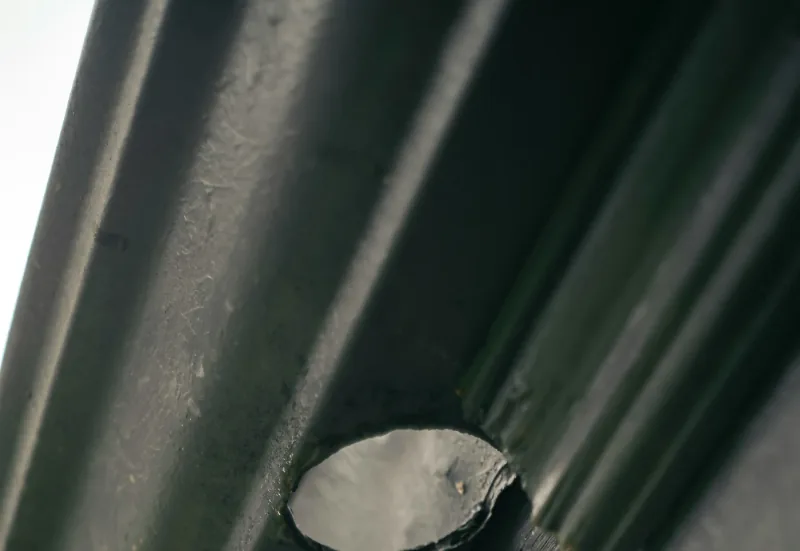
That matters because gutters in this region almost never fail in the metal. They fail at the fastening, and there are only two fastenings in common use. Spike-and-ferrule is a long nail driven through both walls of the gutter into the fascia, standard on houses built before roughly the mid-1990s. A nail holds by friction along its shank, wet timber surrenders that friction first, and every thermal cycle and every load of soaked debris draws it a fraction further out. Once it stands proud you cannot fix it by hammering it back, because the hole is now bigger than the nail. Hidden hangers screw into the board instead, and a thread engages timber rather than gripping it.
So the diagnosis on any leaking or sagging run in Kannapolis runs in one order: test the board, then choose the fastening, and only then discuss sealant. A bead of sealant over a joint that is moving buys a season, which is why so many gutters here carry three visible generations of somebody else's attempt.
Where the board is sound, re-hanging on hidden hangers at 24-inch centres with the pitch reset is $4 to $8 a foot and it lasts. Where it is soft, the fascia is the repair at $12 to $22 a foot, and hanging new gutter on wet timber is buying the same failure again at full price. We probe before we quote, in Kannapolis as everywhere else, because a stained board and a rotten one look identical from the drive.
What Kannapolis itself changes
The housing in Kannapolis
Kannapolis has a barbell distribution rather than a normal one: 29.7% of its housing predates 1960, in the former Cannon Mills village, and 40.7% was built in 2000 or later, in the redevelopment that followed. The middle is thin. For gutters this is not just an age difference, it is a geometry difference. Mill-village houses were built small and close together with shallow, narrow eaves, and the modern stock has the deep overhangs and large roof planes of contemporary building. The same profile does not sit well on both.
Getting to the gutters
The mill-village streets are tight, small lots, houses close to the pavement and to each other, and limited room to set a ladder at the correct angle on the side elevations. Working there is slower and it is worth saying so rather than pricing it as if it were open subdivision. The newer half is straightforward two-storey work with proper drives. The county line runs through parts of the town, which complicates addresses more than it complicates ladders.
Permits and where water goes
Hanging gutter on an existing house does not normally require a building permit anywhere in this service area, and we will tell you that rather than adding a line for a permit nobody filed. What can require one is tying a downspout into a buried or municipal storm drainage system, which is reviewed locally and occasionally differs from one address to the next. Kannapolis is reviewed by the City of Kannapolis together with Cabarrus County, and the Cabarrus and Rowan county line running through parts of the town means the answer genuinely depends on the address rather than the postal town.