



What is holding the gutter up in Gastonia
Spike-and-ferrule on the majority of pre-1980 stock, frequently with the nails partly withdrawn and the run sagging between them. Underneath that, a fascia board that has been wet at the fastening points for decades and may or may not still hold a screw, which is the question that decides whether a run can be saved. Where a Gastonia house has already been re-gutted once, it is usually 5-inch aluminium on hangers and in good order. We probe before we price, because from the street the two situations look identical.
That matters because gutters in this region almost never fail in the metal. They fail at the fastening, and there are only two fastenings in common use. Spike-and-ferrule is a long nail driven through both walls of the gutter into the fascia, standard on houses built before roughly the mid-1990s. A nail holds by friction along its shank, wet timber surrenders that friction first, and every thermal cycle and every load of soaked debris draws it a fraction further out. Once it stands proud you cannot fix it by hammering it back, because the hole is now bigger than the nail. Hidden hangers screw into the board instead, and a thread engages timber rather than gripping it.
So the diagnosis on any leaking or sagging run in Gastonia runs in one order: test the board, then choose the fastening, and only then discuss sealant. A bead of sealant over a joint that is moving buys a season, which is why so many gutters here carry three visible generations of somebody else's attempt.
Where the board is sound, re-hanging on hidden hangers at 24-inch centres with the pitch reset is $4 to $8 a foot and it lasts. Where it is soft, the fascia is the repair at $12 to $22 a foot, and hanging new gutter on wet timber is buying the same failure again at full price. We probe before we quote, in Gastonia as everywhere else, because a stained board and a rotten one look identical from the drive.
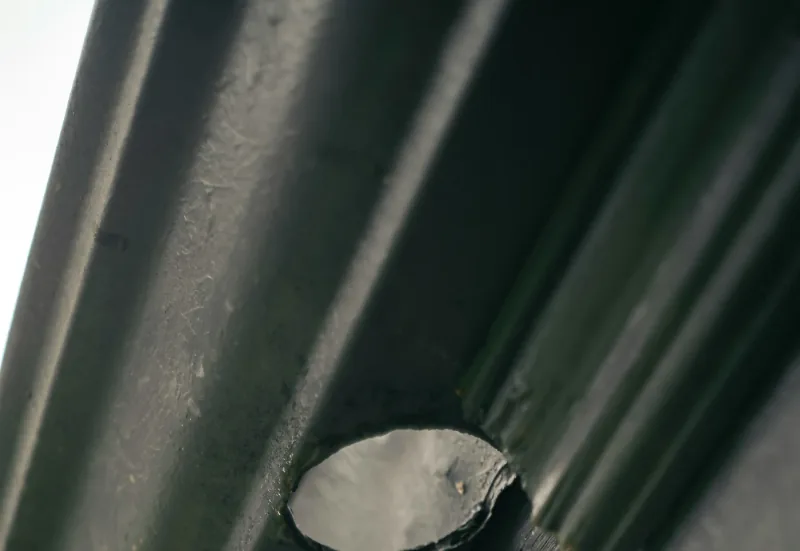
What Gastonia itself changes
The housing in Gastonia
Gastonia holds the largest share of aged housing in the region (52.4% of it predates 1980, against a Mecklenburg median of around 1997), and that single statistic decides what gutter work here looks like. Houses built before roughly the mid-1990s were gutted with spike-and-ferrule: a long nail driven through both walls of the gutter into the fascia. Nails hold by friction, friction fails once the timber gets wet, and forty years of wetting cycles have drawn most of them progressively outward. This is why so many Gastonia gutters carry a row of proud nail heads along the front, and why re-hanging rather than replacing is the dominant job in this town.
Getting to the gutters
Mostly single-storey and modest two-storey houses on regular lots, which keeps the access surcharge off a lot of Gastonia quotes and makes this one of the more affordable towns in the metro to have gutter work done. Driveways are generally adequate for the trailer. The complication is not height but ground: several of the older neighbourhoods sit on noticeable slopes, and a ladder position on a fall needs setting up properly rather than improvised.
Permits and where water goes
Hanging gutter on an existing house does not normally require a building permit anywhere in this service area, and we will tell you that rather than adding a line for a permit nobody filed. What can require one is tying a downspout into a buried or municipal storm drainage system, which is reviewed locally and occasionally differs from one address to the next. Gaston County reviews all trades across the whole county rather than splitting it between town and county offices, which makes the answer in Gastonia unusually simple compared with most of this service area.