



What actually falls on Belmont roofs, and when
The mill villages have mature street planting on small close-set lots, so canopy sits almost immediately over the roofs and the eaves are well inside the drip line. The newer riverside development is open and lightly treed. Belmont sits at the confluence of the Catawba and the South Fork, and the river corridors carry heavier and more varied vegetation than the town away from the water.
That is the part national advice cannot tell you. Almost every article on this subject says twice a year, spring and autumn, and books the autumn visit for October. Across this metro that timing is wrong, because the dominant street tree is the willow oak (roughly 200,000 street trees in Charlotte, a significant share of them oak), and willow oak holds its leaves late, dropping through late autumn and into winter rather than in one convenient fortnight. A single clean booked for October happens in the middle of the drop rather than at the end of it.
So under real canopy the useful pattern in Belmont is one visit once the drop has genuinely finished, in late December or January, and a second in spring, which here is not a leaf job at all. Spring is pine pollen, catkins and seed, and it washes into the outlets and sets there. A spring visit is a downspout job with a gutter attached.
Whatever the schedule, the visit finishes the same way anywhere we work: hand-cleared into a bucket rather than blown off the roof, every downspout flow-tested with a hose, and photographs from the ladder of every run before and after. You are hiring us precisely because you are not going up there, so you get the evidence rather than the assurance.
What Belmont itself changes
Getting to the gutters
The mill-village streets are tight: houses close together, small lots, limited room to set a ladder at a proper angle on side elevations, and frequently a neighbour’s property within a few feet. It is slower work and we price it as such rather than pretending it is equivalent to subdivision access. The newer riverside housing is conventional and easy, though several properties sit on the fall towards the water with a taller elevation on the river side.
The housing in Belmont
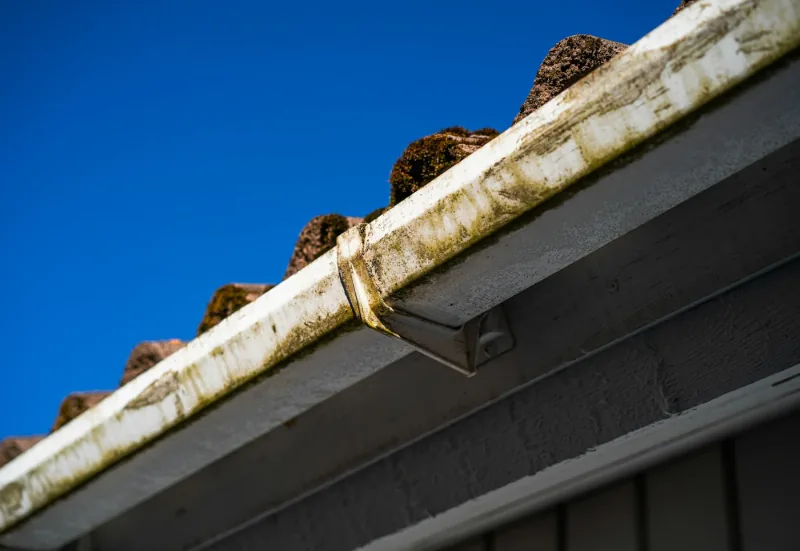
Belmont built nearly twenty textile mills up to 1930 and the villages that housed their workers are still standing and still lived in, alongside newer riverside and infill development from the last fifteen years or so. The mill houses present the single most specific gutter problem in this service area: they were built small, with shallow overhangs, and in many cases with exposed rafter tails rather than a continuous fascia board. There is often nothing behind the gutter to screw a hanger into, which is why so many of them carry gutter fastened in ways that were never going to last.