



What a Belmont roof costs to reach
Two things decide an installation price once the footage is known: what profile the roof needs, and what it takes to physically get to it. The second is where most of the variation between quotes in Belmont comes from.
The mill-village streets are tight: houses close together, small lots, limited room to set a ladder at a proper angle on side elevations, and frequently a neighbour’s property within a few feet. It is slower work and we price it as such rather than pretending it is equivalent to subdivision access. The newer riverside housing is conventional and easy, though several properties sit on the fall towards the water with a taller elevation on the river side.
That is why our access surcharge is a named percentage on the affected runs rather than a number folded into the total. On a single-storey elevation there is none. Above the first floor it is 20% to 35% on those runs only, because the work genuinely takes longer and carries more risk at height, and you should be able to see exactly which part of the quote it applies to.
Everything else is arithmetic. Gutter at $8 to $17 a foot depending on profile, downspouts at $9 to $18 a foot of vertical, removal of the old system at $1.50 to $3, and fascia board only where it will no longer hold a fastener. Our minimum job anywhere in Belmont is $450, because a half-day with two people and a forming machine costs the same whether the run is twenty feet or sixty.
The permit question is simpler than most trades make it sound. Hanging gutter on an existing house in Belmont does not normally require a building permit, and we say so rather than adding a line for one nobody filed. What can require review is tying a downspout into a buried or municipal storm system, and in Belmont that goes through Gaston County, which reviews all trades across the county. We confirm it against the actual address before quoting anything that goes underground.
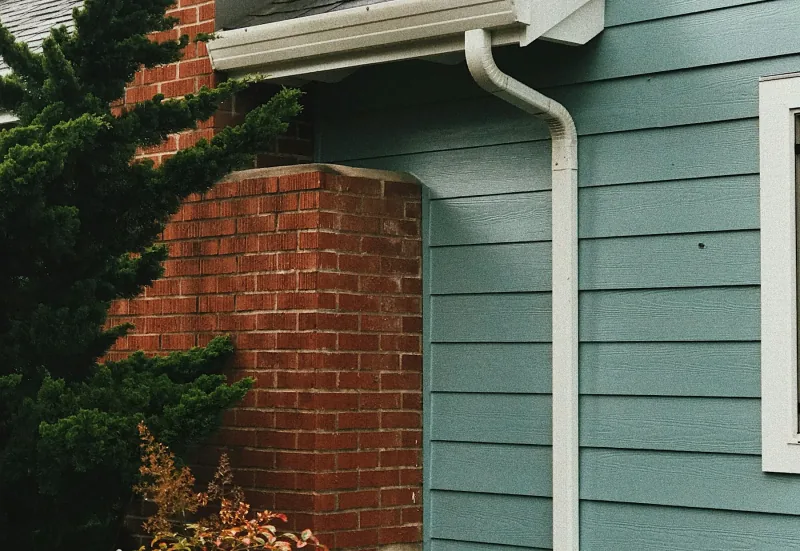
What Belmont itself changes
The housing in Belmont
Belmont built nearly twenty textile mills up to 1930 and the villages that housed their workers are still standing and still lived in, alongside newer riverside and infill development from the last fifteen years or so. The mill houses present the single most specific gutter problem in this service area: they were built small, with shallow overhangs, and in many cases with exposed rafter tails rather than a continuous fascia board. There is often nothing behind the gutter to screw a hanger into, which is why so many of them carry gutter fastened in ways that were never going to last.
What drops on these roofs
The mill villages have mature street planting on small close-set lots, so canopy sits almost immediately over the roofs and the eaves are well inside the drip line. The newer riverside development is open and lightly treed. Belmont sits at the confluence of the Catawba and the South Fork, and the river corridors carry heavier and more varied vegetation than the town away from the water.
What is up there now
On the mill houses, the fastening question dominates everything. Where there is no proper fascia, the honest options are fitting a fascia board first so there is something to hang from, or using rafter-tail brackets fixed to the tails themselves, and both cost more than a standard hanger job. Anyone quoting a straight per-foot rate on a mill house without looking at what is behind the eaves has not priced the actual work. The newer half is ordinary 5-inch aluminium on hidden hangers.