



What profile will actually fit in Belmont
On the mill houses, the fastening question dominates everything. Where there is no proper fascia, the honest options are fitting a fascia board first so there is something to hang from, or using rafter-tail brackets fixed to the tails themselves, and both cost more than a standard hanger job. Anyone quoting a straight per-foot rate on a mill house without looking at what is behind the eaves has not priced the actual work. The newer half is ordinary 5-inch aluminium on hidden hangers.
Seamless does not change any of that, and it is worth being precise about what it does change. The machine sits on a trailer at the kerb and rolls flat aluminium coil into finished profile at whatever length is called for, so a 46-foot elevation becomes one 46-foot piece with no joint anywhere along it. Sectional gutter would have four connectors in that run, each one a place for sealant to fail and debris to catch.
What seamless does not remove is the joints at the corners and the end caps, and those are where gutters actually leak, because a mitre sits where two roof planes deliver water at once and at speed. That is why we hand-mitre, two pieces cut to the true angle of your roof rather than a factory 90 riveted in, and why it is included in the rate rather than sold as an upgrade.
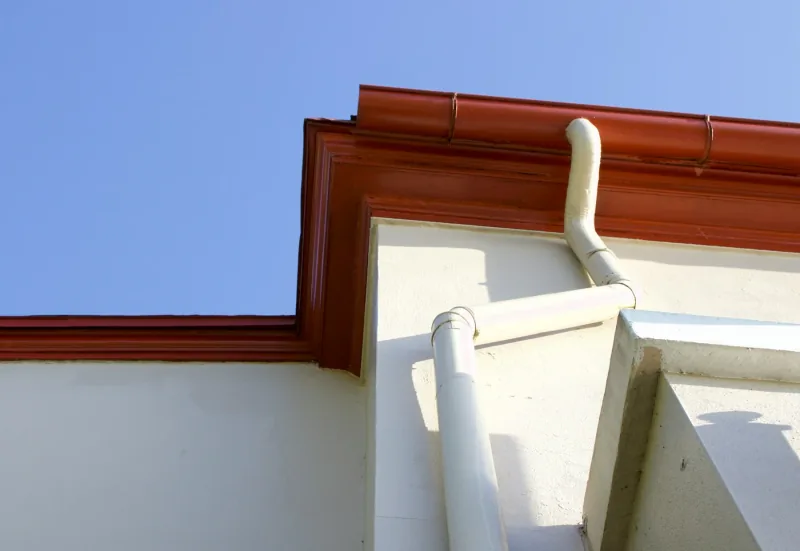
The other question Belmont raises is whether the profile you want will physically sit under the roof edge. Shallow overhangs on older housing frequently rule out 6-inch entirely, and finding that out on the day is somebody's problem. We measure the eaves before ordering, and where more capacity is genuinely needed but a wider trough will not fit, the answer is an additional downspout, which is cheaper anyway.
What Belmont itself changes
The housing in Belmont
Belmont built nearly twenty textile mills up to 1930 and the villages that housed their workers are still standing and still lived in, alongside newer riverside and infill development from the last fifteen years or so. The mill houses present the single most specific gutter problem in this service area: they were built small, with shallow overhangs, and in many cases with exposed rafter tails rather than a continuous fascia board. There is often nothing behind the gutter to screw a hanger into, which is why so many of them carry gutter fastened in ways that were never going to last.
What drops on these roofs
The mill villages have mature street planting on small close-set lots, so canopy sits almost immediately over the roofs and the eaves are well inside the drip line. The newer riverside development is open and lightly treed. Belmont sits at the confluence of the Catawba and the South Fork, and the river corridors carry heavier and more varied vegetation than the town away from the water.