



What actually falls on Salisbury roofs, and when
The historic districts have the mature, deliberately planted street canopy of a town that has been prosperous for a very long time, with large hardwoods over the roofs on most of those streets. It is a heavy and sustained debris load, and it falls on buildings where the cleaning access is among the most difficult in the service area. The newer development at the edges of the city is conventional and much lighter.
That is the part national advice cannot tell you. Almost every article on this subject says twice a year, spring and autumn, and books the autumn visit for October. Across this metro that timing is wrong, because the dominant street tree is the willow oak (roughly 200,000 street trees in Charlotte, a significant share of them oak), and willow oak holds its leaves late, dropping through late autumn and into winter rather than in one convenient fortnight. A single clean booked for October happens in the middle of the drop rather than at the end of it.
So under real canopy the useful pattern in Salisbury is one visit once the drop has genuinely finished, in late December or January, and a second in spring, which here is not a leaf job at all. Spring is pine pollen, catkins and seed, and it washes into the outlets and sets there. A spring visit is a downspout job with a gutter attached.
Whatever the schedule, the visit finishes the same way anywhere we work: hand-cleared into a bucket rather than blown off the roof, every downspout flow-tested with a hose, and photographs from the ladder of every run before and after. You are hiring us precisely because you are not going up there, so you get the evidence rather than the assurance.
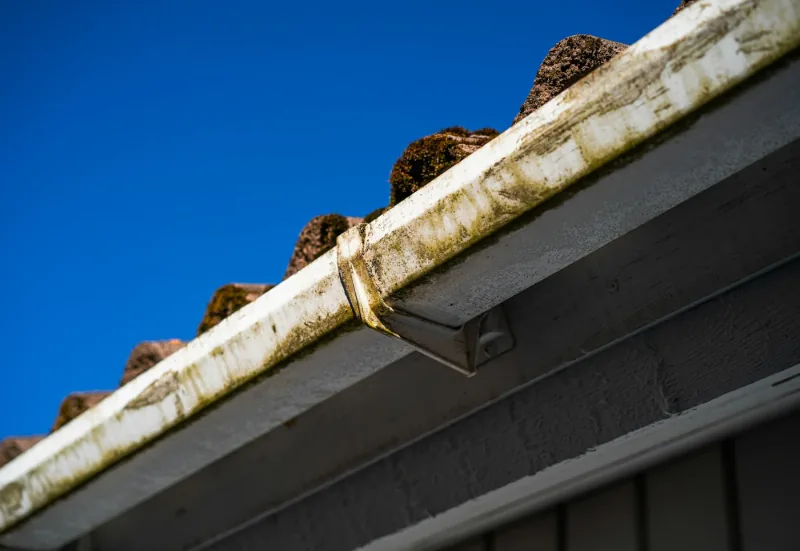
What Salisbury itself changes
Getting to the gutters
Among the hardest in the service area, and for the same reason the buildings are worth looking at. Victorian and Craftsman houses are tall relative to their footprint, with steep pitches, turrets, dormers and wrap-around porches that put runs above roofs rather than above ground. A significant proportion of Salisbury historic work is roof access rather than ladder access and is quoted individually. This is not a town where a per-foot rate quoted over the phone means much.
The housing in Salisbury
Salisbury holds one of the most substantial historic housing stocks in North Carolina: the Salisbury Historic District with hundreds of contributing buildings, plus North Main Street from roughly 1900 to 1930, Brooklyn-South Square and North Long Street-Park Avenue. Late Victorian, Colonial Revival and Craftsman bungalows in real quantity. On buildings of that quality the gutter is part of the elevation rather than a utility bolted to it, and a stock K-style run in a modern finish is a visible compromise on a house that was designed with something else in mind.