



What actually falls on Harrisburg roofs, and when
Light. The subdivisions were built on farmland and the planted trees are still mostly at or below eaves height, so the annual debris load on a typical Harrisburg house is modest and a single yearly clean is usually enough. The older houses along the original crossroads and the properties backing onto the remaining woodland at the town’s edges are the exceptions, and they behave more like Mint Hill than like the rest of Harrisburg.
That is the part national advice cannot tell you. Almost every article on this subject says twice a year, spring and autumn, and books the autumn visit for October. Across this metro that timing is wrong, because the dominant street tree is the willow oak (roughly 200,000 street trees in Charlotte, a significant share of them oak), and willow oak holds its leaves late, dropping through late autumn and into winter rather than in one convenient fortnight. A single clean booked for October happens in the middle of the drop rather than at the end of it.
So under real canopy the useful pattern in Harrisburg is one visit once the drop has genuinely finished, in late December or January, and a second in spring, which here is not a leaf job at all. Spring is pine pollen, catkins and seed, and it washes into the outlets and sets there. A spring visit is a downspout job with a gutter attached.
Whatever the schedule, the visit finishes the same way anywhere we work: hand-cleared into a bucket rather than blown off the roof, every downspout flow-tested with a hose, and photographs from the ladder of every run before and after. You are hiring us precisely because you are not going up there, so you get the evidence rather than the assurance.
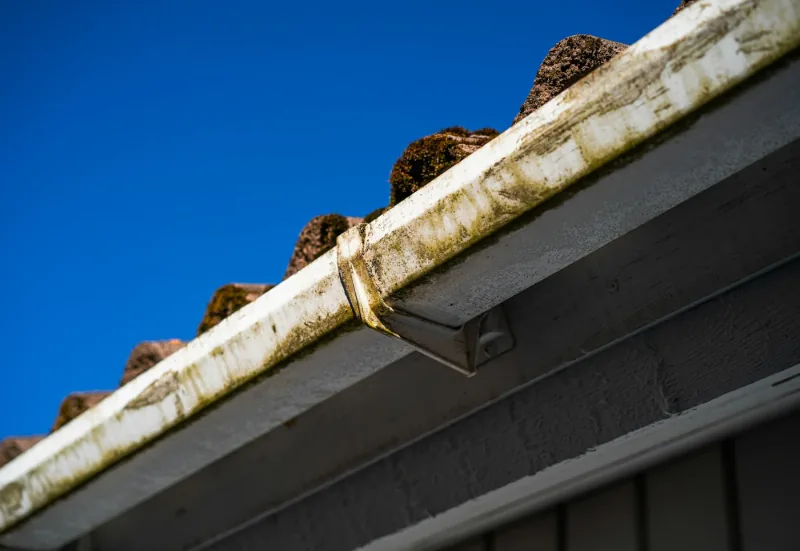
What Harrisburg itself changes
Getting to the gutters
About as uniform as Indian Trail and for the same reason. Modern subdivision layout means level driveways, standard setbacks, predictable two-storey elevations and clear ladder positions, so quotes given over the phone here are reliable and the standard access surcharge covers what it needs to. Trailer positioning is rarely a consideration.
The housing in Harrisburg
Harrisburg went from a crossroads to a commuter town inside about twenty years, in subdivision waves running from the late 1990s onward, and whole streets here were completed within a year or two of each other. The gutters therefore reach every stage of their life together. What makes Harrisburg genuinely different from the other concentrated-cohort towns is how recent that building is: the fascia boards on most of these houses are twenty-five years old at the outside, and a young sound board is what makes a re-hang possible instead of a replacement.