



Which Harrisburg houses actually justify copper
Harrisburg went from a crossroads to a commuter town inside about twenty years, in subdivision waves running from the late 1990s onward, and whole streets here were completed within a year or two of each other. The gutters therefore reach every stage of their life together. What makes Harrisburg genuinely different from the other concentrated-cohort towns is how recent that building is: the fascia boards on most of these houses are twenty-five years old at the outside, and a young sound board is what makes a re-hang possible instead of a replacement.
Copper earns its place on some of that and not on the rest, and we would rather say which before quoting four to five times the aluminium rate. It belongs on genuine period property, where an aluminium K-style run across original eaves detailing is a visible compromise on a building that deserves better, and on architect-specified work where the metal is a deliberate part of the elevation. On modern subdivision housing it performs no better in any way that matters, because an under-drained copper gutter overflows exactly like an under-drained aluminium one. If the appeal is the look, painted aluminium half-round at $16 to $26 a foot gets most of the way there for roughly a third of the money.
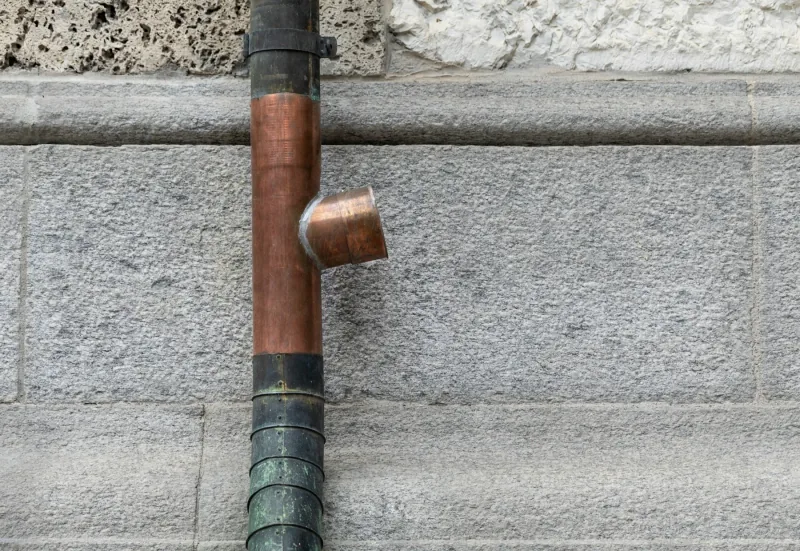
Where copper is right, the specification decides everything. Copper is a noble metal and aluminium is not, so a copper gutter on aluminium hangers makes the hanger the actively corroding half of a galvanic cell, wet, every time it rains, for years. The gutter stays immaculate and the bracket wastes away, and in fifteen years the run comes off a house whose owner was expecting a lifetime. Copper or bronze hangers, copper or stainless fasteners, copper downspouts and straps, and soldered joints rather than sealant.
One check specific to the property rather than the town: copper runoff corrodes bare aluminium and galvanised steel below it, so anything downstream on the elevation (flashings, a porch roof, an existing downspout) gets looked at before we hang a foot of it.
What Harrisburg itself changes
What drops on these roofs
Light. The subdivisions were built on farmland and the planted trees are still mostly at or below eaves height, so the annual debris load on a typical Harrisburg house is modest and a single yearly clean is usually enough. The older houses along the original crossroads and the properties backing onto the remaining woodland at the town’s edges are the exceptions, and they behave more like Mint Hill than like the rest of Harrisburg.
Getting to the gutters
About as uniform as Indian Trail and for the same reason. Modern subdivision layout means level driveways, standard setbacks, predictable two-storey elevations and clear ladder positions, so quotes given over the phone here are reliable and the standard access surcharge covers what it needs to. Trailer positioning is rarely a consideration.