



Which Mint Hill houses actually justify copper
The 2000s are Mint Hill’s single biggest decade at 22%, but the 1970s and 1980s together account for 35% of the housing, and that is the largest pre-1980 concentration of any town in Mecklenburg County. Those decades matter for gutters more than for almost anything else, because they predate hidden hangers becoming standard. A third of Mint Hill therefore carries gutter that was nailed to the fascia forty or fifty years ago and, on the houses nobody has re-gutted since, is still nailed there, progressively less securely with every season.
Copper earns its place on some of that and not on the rest, and we would rather say which before quoting four to five times the aluminium rate. It belongs on genuine period property, where an aluminium K-style run across original eaves detailing is a visible compromise on a building that deserves better, and on architect-specified work where the metal is a deliberate part of the elevation. On modern subdivision housing it performs no better in any way that matters, because an under-drained copper gutter overflows exactly like an under-drained aluminium one. If the appeal is the look, painted aluminium half-round at $16 to $26 a foot gets most of the way there for roughly a third of the money.
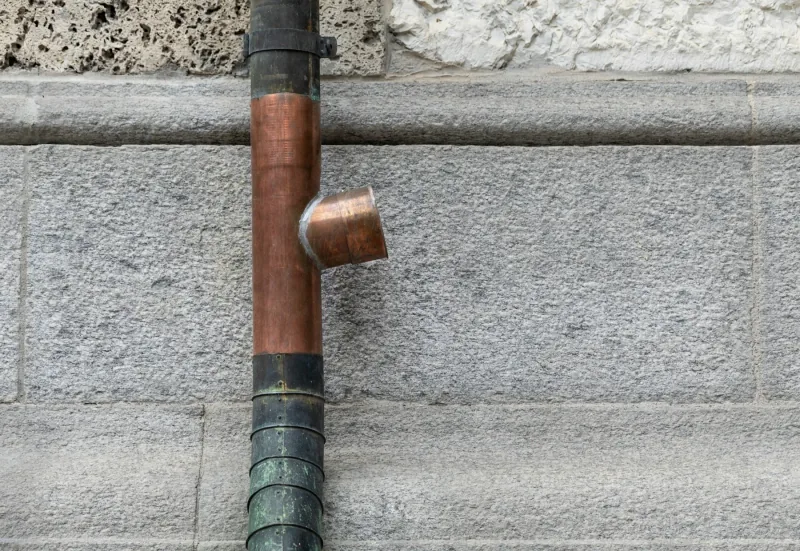
Where copper is right, the specification decides everything. Copper is a noble metal and aluminium is not, so a copper gutter on aluminium hangers makes the hanger the actively corroding half of a galvanic cell, wet, every time it rains, for years. The gutter stays immaculate and the bracket wastes away, and in fifteen years the run comes off a house whose owner was expecting a lifetime. Copper or bronze hangers, copper or stainless fasteners, copper downspouts and straps, and soldered joints rather than sealant.
One check specific to the property rather than the town: copper runoff corrodes bare aluminium and galvanised steel below it, so anything downstream on the elevation (flashings, a porch roof, an existing downspout) gets looked at before we hang a foot of it.
What Mint Hill itself changes
What drops on these roofs
Heavy, and heavier than most of Mecklenburg. Mint Hill retained far more of its original tree cover through development than the subdivision towns to the south did, and the 1970s and 1980s neighbourhoods in particular sit under substantial mature hardwood with the eaves well inside the drip line. This is one of the towns where a gutter guard is genuinely worth the money rather than an upsell, and where the willow oak timing argument applies most forcefully.
Getting to the gutters
Large lots, generous setbacks and mostly modest two-storey or split-level houses, which makes for comfortable ladder work and easy trailer positioning. What Mint Hill does have is long driveways and a semi-rural layout in parts, so the walk from the trailer to the far elevation can be longer than the ladder work itself. Ground is generally level and stable.