



Which Kannapolis houses actually justify copper
Kannapolis has a barbell distribution rather than a normal one: 29.7% of its housing predates 1960, in the former Cannon Mills village, and 40.7% was built in 2000 or later, in the redevelopment that followed. The middle is thin. For gutters this is not just an age difference, it is a geometry difference. Mill-village houses were built small and close together with shallow, narrow eaves, and the modern stock has the deep overhangs and large roof planes of contemporary building. The same profile does not sit well on both.
Copper earns its place on some of that and not on the rest, and we would rather say which before quoting four to five times the aluminium rate. It belongs on genuine period property, where an aluminium K-style run across original eaves detailing is a visible compromise on a building that deserves better, and on architect-specified work where the metal is a deliberate part of the elevation. On modern subdivision housing it performs no better in any way that matters, because an under-drained copper gutter overflows exactly like an under-drained aluminium one. If the appeal is the look, painted aluminium half-round at $16 to $26 a foot gets most of the way there for roughly a third of the money.
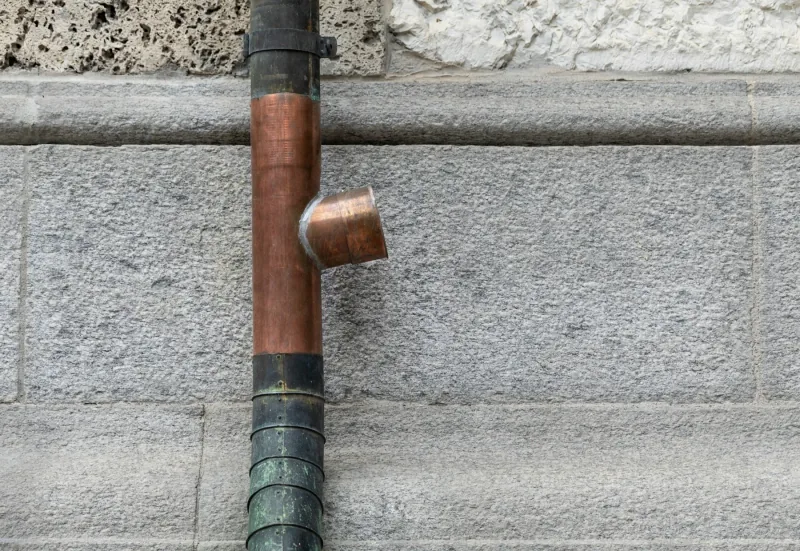
Where copper is right, the specification decides everything. Copper is a noble metal and aluminium is not, so a copper gutter on aluminium hangers makes the hanger the actively corroding half of a galvanic cell, wet, every time it rains, for years. The gutter stays immaculate and the bracket wastes away, and in fifteen years the run comes off a house whose owner was expecting a lifetime. Copper or bronze hangers, copper or stainless fasteners, copper downspouts and straps, and soldered joints rather than sealant.
One check specific to the property rather than the town: copper runoff corrodes bare aluminium and galvanised steel below it, so anything downstream on the elevation (flashings, a porch roof, an existing downspout) gets looked at before we hang a foot of it.
What Kannapolis itself changes
What drops on these roofs
The mill village has the mature street trees of a neighbourhood approaching a century old, planted close to the houses on small lots, so the canopy sits almost directly on the roofs. The post-2000 redevelopment is open and lightly planted. It is one of the sharpest contrasts in the service area, and it means two Kannapolis addresses can genuinely need different cleaning frequencies rather than differing by a matter of preference.
Getting to the gutters
The mill-village streets are tight, small lots, houses close to the pavement and to each other, and limited room to set a ladder at the correct angle on the side elevations. Working there is slower and it is worth saying so rather than pricing it as if it were open subdivision. The newer half is straightforward two-storey work with proper drives. The county line runs through parts of the town, which complicates addresses more than it complicates ladders.