



Which Landis houses actually justify copper
Landis was incorporated in 1901 and built around textile milling, and its housing is small, older and largely owner-occupied. The recurring theme in this town is that the constraint on a gutter job is physical rather than financial. Shallow overhangs limit what profile will sit under the roof edge. Small lots limit where a ladder can stand. Short elevations limit how much gutter there is to price. None of those are things a homeowner can be expected to know before calling, and all of them change the answer.
Copper earns its place on some of that and not on the rest, and we would rather say which before quoting four to five times the aluminium rate. It belongs on genuine period property, where an aluminium K-style run across original eaves detailing is a visible compromise on a building that deserves better, and on architect-specified work where the metal is a deliberate part of the elevation. On modern subdivision housing it performs no better in any way that matters, because an under-drained copper gutter overflows exactly like an under-drained aluminium one. If the appeal is the look, painted aluminium half-round at $16 to $26 a foot gets most of the way there for roughly a third of the money.
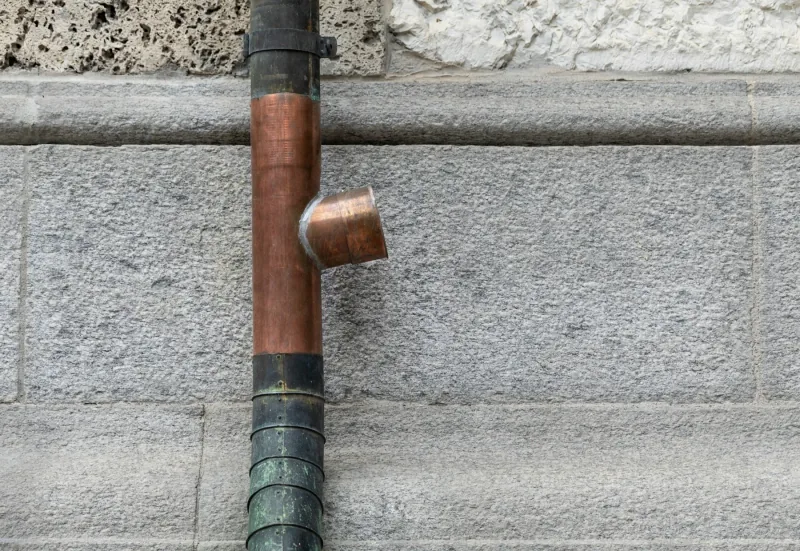
Where copper is right, the specification decides everything. Copper is a noble metal and aluminium is not, so a copper gutter on aluminium hangers makes the hanger the actively corroding half of a galvanic cell, wet, every time it rains, for years. The gutter stays immaculate and the bracket wastes away, and in fifteen years the run comes off a house whose owner was expecting a lifetime. Copper or bronze hangers, copper or stainless fasteners, copper downspouts and straps, and soldered joints rather than sealant.
One check specific to the property rather than the town: copper runoff corrodes bare aluminium and galvanised steel below it, so anything downstream on the elevation (flashings, a porch roof, an existing downspout) gets looked at before we hang a foot of it.
What Landis itself changes
What drops on these roofs
Moderate, with the close street planting typical of a small mill town on compact lots, so what canopy there is sits directly over the roofs rather than at a distance. It is a lighter overall load than the historic Salisbury districts a few miles north, because the trees are smaller and the roof areas beneath them are smaller too, but the ratio of debris to available gutter capacity is not favourable.
Getting to the gutters
The defining practical issue. Houses sit close to each other and close to the street on small plots, and on several of the older streets there is simply not enough clearance beside a house to set a ladder at a safe angle against a side elevation without standing on a neighbour’s ground. That gets arranged rather than assumed. Everything is low, so height is not the difficulty; room is.