



Which Mount Holly houses actually justify copper
Almost everything written about Gaston County housing describes Gastonia and then assumes the rest follows, which produces exactly the wrong answer for Mount Holly. This town is 49.1% built since 2000, with a median home value of $337,800, which makes it newer than the Gaston County average and newer than Mecklenburg County. The practical consequence for gutters is that the spike-and-ferrule problem which dominates Gastonia barely exists here. Half of Mount Holly is on its first gutter, hung on hidden hangers, with the fascia still young.
Copper earns its place on some of that and not on the rest, and we would rather say which before quoting four to five times the aluminium rate. It belongs on genuine period property, where an aluminium K-style run across original eaves detailing is a visible compromise on a building that deserves better, and on architect-specified work where the metal is a deliberate part of the elevation. On modern subdivision housing it performs no better in any way that matters, because an under-drained copper gutter overflows exactly like an under-drained aluminium one. If the appeal is the look, painted aluminium half-round at $16 to $26 a foot gets most of the way there for roughly a third of the money.
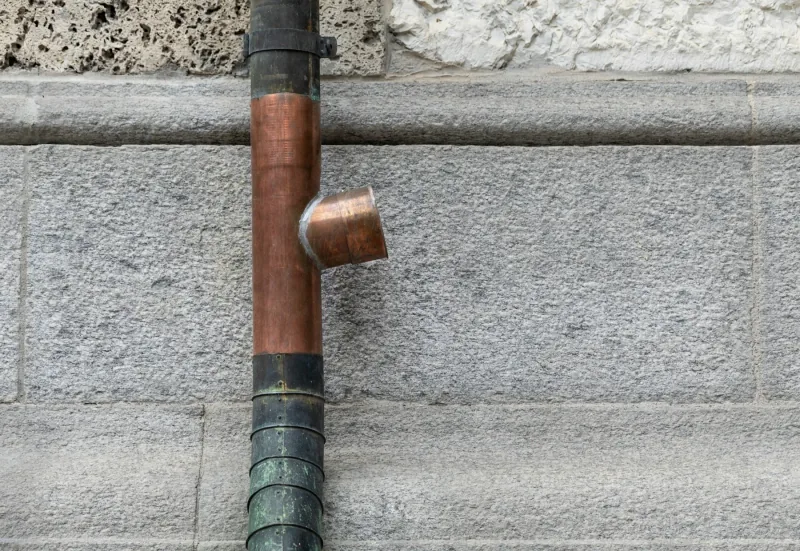
Where copper is right, the specification decides everything. Copper is a noble metal and aluminium is not, so a copper gutter on aluminium hangers makes the hanger the actively corroding half of a galvanic cell, wet, every time it rains, for years. The gutter stays immaculate and the bracket wastes away, and in fifteen years the run comes off a house whose owner was expecting a lifetime. Copper or bronze hangers, copper or stainless fasteners, copper downspouts and straps, and soldered joints rather than sealant.
One check specific to the property rather than the town: copper runoff corrodes bare aluminium and galvanised steel below it, so anything downstream on the elevation (flashings, a porch roof, an existing downspout) gets looked at before we hang a foot of it.
What Mount Holly itself changes
What drops on these roofs
Light across the newer half of the town, which was developed on open ground with planting that has not yet closed over the roofs, and moderate in the older streets near the river and the original centre. Mount Holly sits on the Catawba, and river-adjacent lots hold noticeably more mature hardwood than the newer development away from the water. As a whole this is a lighter debris load than its neighbours across the county.
Getting to the gutters
Straightforward modern subdivision work over most of the town, level drives, standard setbacks, ordinary two-storey elevations. The older streets near the river centre are tighter and include a number of properties on sloping ground running down towards the water, where a ladder position needs proper setting up rather than improvising on a fall.